Adopt-a-Village in Guatemala

Adopt-a-Village in Guatemala

a partnership for education

  • HOME
  • Empowering Mayan Youth Toward a New Future
  • ABOUT US
    • Celebrating 20 Years with the Maya
      • Photo Gallery
    • History
    • Who we are
    • Where we work
    • What we do
  • OUR PROGRAMS
    • Child Sponsorship
      • Children Awaiting Sponsors
    • Orphans and Widows
    • Medical Emergency Fund
  • GET INVOLVED
    • Volunteer
    • Give now
  • CONTACT US
    • The Mayan Center
  • AAV BLOG

Volunteering in a Rainforest

Posted in AAV by admin
Mar 10 2012
TrackBack Address.

AAV's mountain retreat offers unique adventures

Preparing for a visit from our child sponsors always creates a flurry of excitement at the Mayan Center—laying in food and water, sweeping out the cobwebs from the volunteer cabin, making a list of the tasks at hand, planning trips to visit the children.

Last month, Gary Owen, sponsor of two children, made the trip with his good friend, Roy Krausen.  Our visitors, both from California, have always enjoyed traveling to places off the beaten track where they can immerse themselves with a different culture and authentic adventures. We were delighted when they offered to volunteer their valuable construction skills in order to complete the kitchen at the new Nutrition Center.

Gary had learned about Adopt-a-Village five years ago while on a previous trip to Guatemala; this current trip would be his third time to volunteer for Adopt-a-Village.  The two friends spent 10 days building shelving, counter-tops, and roof-beam supports, as well as installing a plywood floor.  Apart from work, they hiked through a magnificent rainforest where the endangered Resplendent Quetzal nests, viewed the water-holes built for the wild animals during dry season, enjoyed a swim at Lake Maxbal, the pristine limestone-sink lake near

Volunteer Gary Owen and Pascual Domingo

the school’s property, and learned about edible rainforest plants, like momon, (so called by the Maya) a wild herbaceous perennial plant. (The crunchy, tangy stalk-like vegetable, tasting like a mix of celery and ginger, is added to soups, scrambled eggs, and stir-fries at the school kitchen).

We have to think that by making this bone-jarring trip through rugged mountain terrain three times indicates that time spent with the Maya at our rainforest retreat is definitely worthwhile!   Perhaps Gary’s friend, Roy, echoes his thoughts when he says, “… if we accomplished just a little bit at the school, it pales to the great experience and fun of working there.”  Giving back, having fun—a great combination for a great vacation!


We welcome volunteers with skills in sustainable gardening, nutrition, carpentry, mechanics, teaching, and more.  Contact us at guatvillage@aol.com.

No Comments yet »
Tagged as: child sponsorship, guatemala, maya, quetzal, rainforest, sustainable agriculture, volunteer

Florida High School Students Volunteer to Combat Chronic Child Malnutrition

Posted in AAV by admin
Feb 05 2012
TrackBack Address.

The Venice, Florida, Interact Club, a group of 40 high school students, is working with Adopt-a-Village in Guatemala by supporting a scholarship for an indigenous student at our Mayan Center for Education and Development.

The club’s goal is two-fold—alleviate hunger by supporting a scholarship in sustainable agriculture.  In the remote indigenous villages in Guatemala, little opportunity exists to gain an education past 6th grade, due to the extreme poverty of the region.  First, the Interact scholarship will put a Mayan student in an accelerated program, enabling him to complete three years of schooling in just two. A diploma opens doors to university studies, professional training, or management of a small business.  Second, the scholarship, by providing specialized training in sustainable food production, will benefit hundreds of indigenous children with nutritious food, thus helping to stem the severe malnutrition in the region.

Interact students sell Guatemalan crafts

Jane Mendola, Lead Interact Advisor and Rotarian of the Venice/Nokomis Rotary Club, says, “By training one student, our Interact Club is clearly helping to combat malnutrition of Guatemalan children.  The country suffers from the worst level of chronic child malnutrition in Latin America and the fourth highest level in the world.   Chronic malnutrition limits physical growth with the result that children’s bodies are stunted and highly vulnerable to disease and illness. It causes irreversible brain damage—leaving them unable to function well in school or in later life”.


Manuel wins a scholarship

Imparting one student’s expertise in growing food sustainably can positively impact at least 100 villagers.  Every student at the Mayan Center of Education is required to share his/her training in how to produce “super foods” (for instance, vegetables with the highest nutritional values). From “growing” soil (using green composting methods)—to using special planting techniques, to harvesting seeds for the next year’s crops—parents can change the health of their children for the better.

The motto “Train a student, transform a village,” is being marched out to the Venice and Nokomis communities where Interacters are selling hundreds of hand crafted Guatemalan key chains to raise funds.  Their one-of-a-kind international project just hit its midway funding mark last month, thanks to the enthusiastic participation of club members.  Their final goal—raise $2,000 for the annual scholarship.

Mendola says, “our Venice Interact Club is not just helping one student, it is helping entire villages—they are doing something vitally important that is improving the lives of many.  The Interact Club has really taken this project to heart and our facilitators at Rotary and Faculty Advisor at the Venice high school are very proud of them.”

If you belong to a group that would like to support a student, please Frances Dixon guatvillage@aol.com. 


No Comments yet »
Tagged as: chronic child malnutrition, guatemala, indigenous, maya, Mayan Center for Education, Mayan students, sustainable agriculture, Volunteers

Final Installment…The Guatemala War Redirects a Boy’s Life

Posted in AAV by admin
Jan 18 2012
TrackBack Address.

Previously, we wrote that several graduates, including Juan Diego, would be interviewed and assessed for a coveted internship at the Mayan Center for Education and Development. 

When the Guatemalan Civil War ended in 1996, Juan Diego was seven years old.  He would grow up in a time of hope that the Peace Accords would bring better health, education, and economic times to his people—but, sadly, he would reach manhood to realize the failure of that hope.  Today, his people are hungrier than they were 50 years ago when the war began.  Now, chronic malnutrition threatens to destroy a generation.

As the main breadwinner of his family, young Juan Diego had certainly known hunger.  But those were in the days before staples such as corn and beans had not doubled, tripled and quadrupled in price.  A year ago, six tortillas could be purchased for 12 cents.  Today, one cannot get more than three or four for the same price.  Juan has neighbors who cannot afford to eat beans.  Rice is a luxury—meat, eggs, and cheese don’t show up on a Mayan family’s table in this distant corner of northwestern Guatemala.

The future of this current generation is clearly threatened.  Chronic malnutrition deprives bodies of vital proteins, stunting physical growth.  Without sufficient nutrients, brain capacity diminishes, sometimes up to 40%.  Willem van Milink Paz, a representative for the World Food Program in Guatemala, calls chronic malnutrition a “life sentence” that condemns generation after generation.

How to turn the tide of this tragedy when poverty is so extreme that parents can’t afford to buy even sufficient food staples?  With a small plot of land and a hand up from Adopt-a-Village, self-help gardens can produce food.  We believe that using sustainable agricultural practices in villages is the best way to combat chronic malnutrition—starting small—mother by mother, father by father, village by village —teaching, encouraging, empowering.  From the first step in building nutrient-rich soil in family plots through the interim steps that produce highly nutritious food, our Mayan friends can create an ongoing cycle of food—a cycle of life.

Who better to lead such a movement than a Maya who first-hand understands his people’s plight—their hunger, their deprivation, their need to work hard to survive?   Who better than one of our own graduates armed with specific knowledge in sustainable agriculture?  Who better than a young person known to be responsible, resourceful, a leader?   Juan Diego, of course!

Juan was awarded the coveted internship and took his place alongside the small but growing contingency of Mayan teachers at the Center.  He will teach the incoming students the basic elements of sustainable gardening; and he will train families in outlying communities, empowering them in the art of growing nutritious food.

Adopt-a-Village embraces 2012 with a two-fold goal:  First, expand the number of villages currently receiving training; and second, introduce a community training program at the Mayan Center where parents can learn advanced techniques in gardening and nutrition.  The Mayan Center’s Nutrition Center and demonstration garden will serve as the base where courses in organic pest and disease control will be taught.   Parents will learn how to choose the principal vegetables for nutritional value and how to preserve nutrients when cooking the food, as well as seed harvesting techniques and food storage methods.  With these skills, they can return home, using this knowledge to build a foundation of health for themselves and their children

Through a simple but effective plan of harnessing the educational resources of the Adopt-a-Village Mayan Center, chronic child malnutrition can be combated.  Families have already demonstrated that they are eager to learn these new skills that can restore their health, vigor and dignity.  Self-help gardens, not food handouts, can help them to attain this goal.    Join us in this unique partnership—your help in purchasing seeds and tools and supporting the training of young Mayans like Juan Diego can make a powerful and positive impact in their future.

No Comments yet »
Tagged as: chronic child malnutrition, guatemala, Guatemalan civil war, indigenous, maya, Mayan Center for Education, Mayan students, sustainable agriculture

Self-Help Gardens Bring Food Security

Posted in AAV by admin
Jan 06 2012
TrackBack Address.

Twenty mothers from  Santa Elena, a Q’anjoba’l Mayan village just south of the Mexican border, received their first batch of vegetable seedlings for the New Year from Adopt-a-Village.  This self-help program empowers villagers to learn the techniques of sustainable gardening so that they can be assured of ongoing food for their children.

Non-hybrid seeds that can be harvested and grown successfully for future plantings are provided from the Mayan Center of Education, the Adopt-a-Village unique school that trains indigenous students in academics and sustainable agriculture.  A major goal of the school is to combat the chronic child malnutrition in the region.

No Comments yet »
Tagged as: chronic child malnutrition, food security, guatemala, indigenous, maya, self-help gardens, sustainable agriculture

Continued from…The Guatemalan War Redirects a Boy’s Life

Posted in AAV by admin
Jan 02 2012
TrackBack Address.

In our last post, we wrote that Juan Diego’s grandfather asked Adopt-a-Village to consider his grandson for a scholarship at the Mayan Center for Education and Development…

Juan Diego (center) celebrates graduation with friends

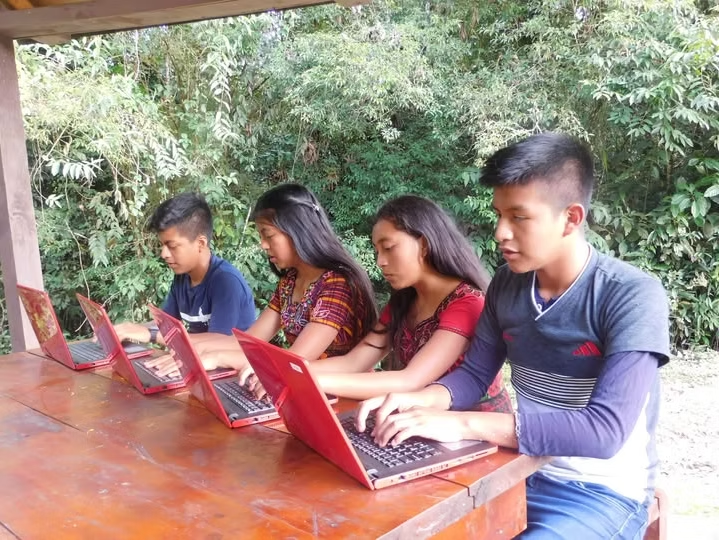
The Mayan Center, located on a mountaintop, isolated from the distractions and pollution of population centers, is a very desirable facility at which to study for several reasons. Foremost, the school offers a two-year accelerated curriculum that puts a student on a fast track to a high school diploma, thus saving time and money to enter higher education or begin working.  That prized certificate, possessed only by a small percentage of Mayan youth, opens the doors to university advancement, professional training, or managing a small business.  Additionally, the Center’s students receive 30% more class time than what is offered at “in town” schools (classes run all day, not half days as in other schools).  Individual use of computers and Internet service are provided.  In other schools, groups of six or more students must share one computer during lessons; and, they must pay for computer time at Internet cafes in order to complete homework assignments.  The Mayan Center boasts a large library, a rarity in any level of school in rural Guatemala.  Ready access to books and computer equipment provides an enhanced opportunity to learn more and thus gain better grades that assist them in gaining entry to university or employment.

A feature important to parents is the school’s 18-day intensive study timetable that gives a student the ability to spend the remainder of the month at home working to help to help sustain the family.  To win a scholarship, Juan would have to demonstrate certain attributes—speak a Mayan language, demonstrate leadership skills, produce records of good grades, and be financially unable to pay tuition and boarding costs.  He easily demonstrated these requisites.

Juan was awarded a scholarship and lived on the rustic mountain campus with his fellow students for two years.  He studied hard and fulfilled of all his academic obligations. In addition to class time, the school requires that students take part in managing and maintaining the campus with the purpose of building leadership skills.  Work involves keeping the school and campus clean and orderly, tending the student’s vegetable garden, feeding the chickens and cleaning their coop, daily grinding the corn for tortillas and helping to prepare mails, and performing other tasks that support a well-run educational facility.

In addition to a heavy load of academic classes, Juan received intensive training in sustainable organic agriculture.  A component of the training is that students use their skills to help impoverished families in nearby villages.  During their practicum, they work alongside family members, teaching them how to prepare soil, produce green compost, transplant seedlings, use water-saving techniques, and harvest seeds for the next planting.  Juan excelled in the sustainable gardening course. He confided to the school director that his long-term goal was one day to pass along this specialized education to young people by teaching at a high school.

A few weeks ago, Juan Diego graduated as valedictorian of his class.  His long years of struggling during his childhood had given him the needed determination to succeed in winning his high school diploma.  He had clearly shown himself to be a hard worker, responsible, and resourceful.

What would be his next step?  He knew that the school administration was offering an internship to a graduate.  The internship would provide an opportunity to study and teach under senior teachers at the Mayan Center, offer advanced organic agricultural training, and gain paid work experience in nearby villages by teaching sustainable food production.   In its assessment of Juan, the administration noted not only did Juan’s skills meet a challenging set of needs, but also his background could made him ideal and very important candidate for the work he would undertake.  He could be empathetic to the extreme level of poverty the Maya suffer.  He spoke the Q’anjob’al language—the dominant Mayan language of the region.  And he had proved himself to be a dependable leader.

Several graduates would be interviewed and assessed for this desirable position.

To be continued….


No Comments yet »
Tagged as: chronic child malnutrition, education, guatemala, Guatemalan civil war, Guatemalan Peace Accords, indigenous, internship, maya, Mayan Center for Education, sustainable agricultural

Peace Corps Aid for Guatemala Cut

Posted in AAV by admin
Dec 29 2011
TrackBack Address.

Guatemala is one of 20 priority countries that the American government plans to help cut poverty and overwhelmingly high chronic child malnutrition rates.  On the other hand, the Peace Corps announced last week that it has canceled plans to send a contingency of new volunteers to Guatemala next month.  What a loss!  Peace Corps hands-on technical training helps rural families attain low-cost sustainable development from the ground up that can fight poverty and malnutrition.

Kristina Edmunson, a Peace Corps spokeswoman in Washington, said the move stemmed from “comprehensive safety and security concerns.”  Guatemala is one of the Central American countries that is used as a staging point by drug cartels to ship cocaine to the United States from South America.  The escalating drug and organized-crime violence in Guatemala has had much press lately. The country has one of the highest per capita murder rates in Latin America at 42 homicides per 100,000 inhabitants.   (On a comparative level, the murder rate in Mexico is reported to be at 15 per 100,000).

Peace Corps technicians and others like Adopt-a-Village volunteers have the background to teach a variety of skills to empower rural people in improving their lives.  With the rate of chronic child malnutrition in Guatemala now at the 4th highest level in the world, Adopt-a-Village has focused on teaching sustainable agriculture— soil improvement through no-cost green composting, (instead of using expensive chemical fertilizers that leach and eventually exhaust the soil), multi-cropping, correct water usage, and seed harvesting for the next planting—all viable techniques that an impoverished people can use at virtually no financial cost to help themselves out of the grip of ever-worsening hunger.

Although Peace Corps support has been cut to Guatemala, USAID is assisting this “focus country” with another style of foreign aid.  In a recent meeting at which current food security policies were discussed with a USAID official in Guatemala City, Adopt-a-Village representatives were told that USAID does not “support subsistence farming programs,” (perhaps not understanding the difference between “subsistence” and the “sustainable” methods AAV uses).  Rather, the USAID view is that some of the most promising opportunities to lessen poverty and chronic child hunger lie in non-traditional agriculture, horticulture, and coffee exports.  USAID programs have engaged thousands of small-scale coffee growers in the highlands to develop production and participate in the global market. (Some would argue that land would be better used to grow food for hunger-stricken local people).  Additionally, USAID has forged an alliance with the multinational giant, Walmart, which recently bought out Guatemala’s largest family-owned chain of grocery markets. Whereas this government/corporate agricultural partnership provides jobs for some, most of the food grown is exported to other countries in Central American and to the United States. (Google “Feed the Future” program for details on this alliance).

Crime and corporate agricultural goals aside, Adopt-a-Village in Guatemala is committed to staying and continuing to make a difference in the lives of malnourished children.  Come January, we will enter our 21st year of service in northwestern Guatemala.  If you are the adventurous sort, we welcome you to come and volunteer with us—we are especially looking for people with organic gardening skills, carpenters, and Spanish language teachers.  (Fluency in Spanish is a Ministry of Education requirement in schools.  However, our students have been raised speaking one of the Mayan languages and need help in mastering Spanish).

Your support, as always, strengthens our resolve.  As we have stated, our foremost goal is to stem the current devastation of stunted growth and minds of Mayan children permanently impaired by chronic malnutrition.  To achieve this, our progressive school, the Mayan Center for Education, is creating a network of Mayan villages where nutritious food is being grown—but this goal needs your help in order to succeed.

In this time of giving thanks, I want to extend my most heartfelt thanks to you for your past and present commitment to the Maya of Guatemala.   Together we are helping to empower them to make important and meaningful changes in their lives.


No Comments yet »
Tagged as: chronic child malnutrition, education, food crisis, food security, guatemala, indigenous, maya, organic gardens, Peace Corps, self-help food, sustainable agriculture, Volunteers

The Guatemalan War Redirects a Boy’s Life

Posted in AAV by admin
Dec 19 2011
TrackBack Address.

Juan Diego lived in a clapboard shack on a mountainside in abject poverty but had the good fortune to be able to enjoy a magnificent view of the mighty Ixcán River in the valley far below.  Tranquil and peaceful during the dry period, the river broils up muddy and angry during the months of heavy rains.   More than one imprudent man and his mule attempting to cross it have been pulled down to a watery grave in the clutches of its powerful rapids.

The river flows from its source in the Cuchumatanes mountains, drops into the lowland jungle valley near the Mexico border and continues northward into that country.  For all its past and present acts of treason against the Maya, it nevertheless guided thousands of frenzied families as they fled on dark nights from the infamous Ixcán massacres in the early ‘80’s.   Their pathway still exists today.  Walking it, one can imagine the terror of those times—mothers running, babies in sarapes tied on their backs, fathers with toddlers on their shoulders and others grasping their hands—and the older children, barefooted, rushing, desperate not be left behind.

Those were the worst days of the genocide.  Rios Montt, an army general, had just wrested presidential power through a coup d’etat in1982.  He became known as the most violent dictator in Latin America in modern times.

Juan Diego was born a few years later, but it wasn’t until he turned seven that the effects of the civil war caught up with him.  Tragically, it was just after the Peace Accords were signed that his father made the fatal mistake of picking up an abandoned grenade.  His foolish act not only instantly ended his life, but also forever changed the course of his first son’s life.

As the eldest son of four children (Juan’s mother was then pregnant with his little brother), his days changed from childhood play to hard labor in the fields.  His solitary companion was his father’s machete.

Despite the long and lonely work, the lack of food and clothing, the mud floor he slept on under the leaky roof, Juan Diego managed to continue his schooling.  Sometimes, he dropped out for a year when the family’s supply of corn shrunk to a few kernels and it became obvious that the family wouldn’t eat if he didn’t go back to work.

At age 19, he left for the sprawl and grime of Guatemala City in the hope of finding work.  Even though he’d reached adulthood, his culture decreed that his family obligations had not ended.  As the eldest, he was expected to continue to support his mother and younger siblings.

One day, Juan’s grandfather, upon realizing that Adopt-a-Village was about to open the Mayan Center for Education and Development, approached the organization.  If he could locate his grandson (his namesake) in the city, he asked, would we interview him and give him a chance to win one of our scholarships?

To be continued…


No Comments yet »
Tagged as: education, guatemala, Guatemalan civil war, Guatemalan Peace Accords, indigenous, maya, Mayan Center for Education

Students Lead the Way to Combat Chronic Child Malnutrition

Posted in AAV, Mayan Center, Students by admin
Dec 07 2011
TrackBack Address.

There are few schools in the world that can be found on top of a remote mountain, (less one that boasts a resident jaguar as does the Adopt-a-Village Mayan Center).  I know of one distant school in the Chilean mountains, just across the border from Argentina.  It’s on the way to a ski resort, so I’m not really sure that it qualifies. Other educational boarding facilities tout their remoteness, such as another one in the Nevada desert, but really, it’s only half an hour drive to pick up a burger and a six-pack, even though the school administration frowns on the idea.

The Mayan Center for Education is situated in a pristine rainforest four hours north from a bone-jarring drive over four-wheel roads of Huehuetenango’s northernmost supply town of Santa Cruz Barillas.  Even their inhabitants don’t really know where it is and as most are non-aficionados of the wilderness, really don’t wish to know.  Nevertheless, Mayan youth who were born in isolated mountain villages call it home for two years as they live, study, and work on campus to earn their accelerated two-year diploma.  Once in hand, they can choose one of several paths—begin university studies, train in a professional facility, or even start a small business.

In addition to academic classes (where students receive 30% more class time than “city” schools), intensive training is provided in sustainable organic gardening.  Guatemala suffers from the worst level of chronic child malnutrition in Latin America and the fourth highest level in the world, according to United Nations statistics.  Every student graduates with the ability to provide his family and village the help they desperately need to produce sustainable food to stem the staggeringly high rates of child malnutrition from which they suffer.

Mateo Ordoñez, pictured here with his father, Pascual Ordoñez, and the school director, Osman Casteñada, has already introduced to his community the unique methods of soil preparation, green composting and multi-crop planting.  His father, an enthusiastic of the Center’s sustainable organic growing techniques, has volunteered to head up village committees to encourage others in these methods of food production.


No Comments yet »
Tagged as: chronic child malnutrition, education, food crisis, food security, guatemala, Huehuetenango, indigenous, maya, organic gardens, Santa Cruz Barillas, self-help food, sustainable agriculture

A Joyful First Graduation!

Posted in AAV, Students by admin
Dec 02 2011
TrackBack Address.

Our first graduation!  What better way to celebrate the 20th anniversary of Adopt-a-Village?

Only the country’s violent October tropical storms threatened the schedule.  Three days before the ceremony, president Alvaro Colom issued a plea for people not to travel the flooded highways—many of them destroyed by landslides, and mountainsides still collapsing with the heavy rains.  “Travel only in an emergency,” was the edict.  AAV’s director, Frances Dixon, determined that attending the first graduation of the Mayan Center for Education definitely required travel, and after 3 ½ arduous days of re-routing and skirting blocked highways, she reached the isolated mountain school, drenched and muddy.

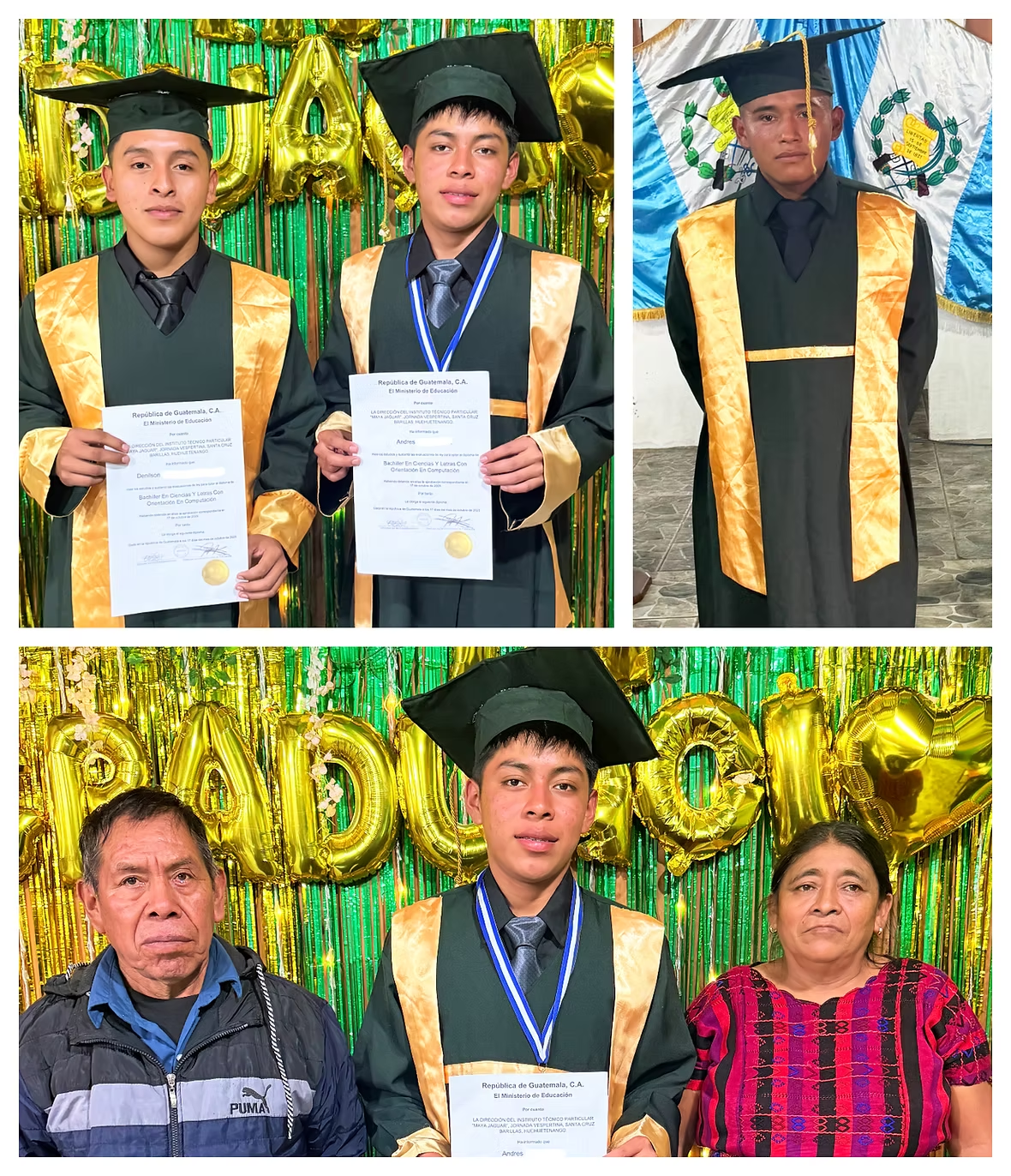
Strains of the marimba music lifted spirits (although not the rain) and signaled that the festivities were about to begin. The school’s colors, green for the mountains and gold for the jaguar that lives nearby, festooned the hall; students proudly presented themselves in their forest-hued shirts and gold satin cummerbunds; and all proudly posed for keepsake photos garbed in a traditional cap and gown.

The ceremony climaxed with smiles and tears as parents rose and stepped forward to embrace their children.  What were they thinking?  Long-held dreams were coming true for them in those joyful moments.  Education had been denied parents in their youth when they found themselves trapped in refuge for years in Mexico during the Guatemala civil war, but in these moments they could rejoice, watching their first children graduate.

Two years of dusk-to-dawn days spent by staff and students living and studying in a remote rainforest mountain campus had paid life-size dividends.   New doors were opening—some students were continuing on to university, others were taking jobs or preparing to begin small businesses, and a top student had won a teaching internship at the Center.

Best of all, students would be sharing their knowledge in their home villages.  Indeed, they had already introduced sustainable organic gardening skills to their families and neighbors, and seven nearby communities had benefited from the students’ instruction during school service projects.  “Train a student, transform a village”—this school motto had born fruit with the first graduation!  Their education had empowered them to create a powerful surge of change in their communities—a change ensuring nutritious food for a people suffering from one of the world’s highest rates of chronic child malnutrition.

Please share these joyful times with us.  You can assure the continuation of a better future for the Maya by giving a scholarship to a deserving student for the 2012 school year.

Give Now

No Comments yet »
Tagged as: chronic child malnutrition, education, food crisis, food security, guatemala, indigenous, maya, organic gardens, scholarships, self-help food, sustainable agriculture

Wild Tomato Makes a Comeback

Posted in AAV by admin
Oct 10 2011
TrackBack Address.

Would you believe these are cherry tomatoes! Not JUST cherry tomatoes, but a little-known tomato indigenous to a far northwestern rainforest region in Guatemala. The plant, along with its bright sanguine tint and subtle sweet flavor flourished for centuries with the aid of the Maya’s master agricultural skills. But in recent decades, the robust miniature has taken a downhill slide toward extinction.
Why? The decades-long Guatemalan civil war, genocidal for the Maya, forced tens of thousands to abandon their lands, flee for their lives, and seek refuge in Mexico. And in their desperate retreat, they abandoned the tiny tomato.
The massive dislocation would endure nearly 20 years until the Maya could finally return safely to their homeland. In the meantime, the forests and jungles had all but swallowed the tomato plants.
Botanically, the cherry tomato is a fruit, classified as a “berry”, although cultivated as a vegetable. Rich in lycopene, a powerful natural anti-oxidant, it has a high level of Vitamin C, and contains Vitamin A, E, and K. Minerals include potassium, iron, calcium, and manganese.
It is purported that this small hardy tomato originated in Peru, South America, although no evidence has been found that it was cultivated there. How it came to be domesticated in Guatemala is unknown—perhaps the seeds were caught up with other produce that traded through ancient routes from South to Central America. It was called the “tomatl”—the swelling fruit. Eventually called the cerasiforme, and is regarded to be the direct ancestor of the modern cultivated tomato. It still grows in a somewhat wild state in Central America, producing small cherry-like fruits on a creeping vine, which we know as a cherry tomato.
The petite tomato began as a curiosity to the early Spanish settlers of Mesoamerica, but that curiosity transformed to widespread consumption when the Spaniards introduced it to their homeland. By the 16th century, tomatoes had traveled widely throughout Europe to Africa and the lands of the Moors (Arabs) where it was known as pome dei Moro (Moor’s apple). In France, it was called pomme d’amour (love apple).
It would not be a simple matter to regenerate the tomatl. Many of the new generation of Maya were born in Mexico and knew nothing of its existence. It would be up to the aging Maya who stayed behind.

Juan Diego

Juan Diego, now a Maya elder, learned how to cultivate the tomatl from his father before the privations of the Guatemalan civil war. (In his Mayan language of Q’anjoba’l, it is called “yalixh pajich”—small tomato) By the age of eight, he was able to produce the crop on his own. He would bundle up the ripe berries in his mother’s sarape and trek to town barefoot—a hike of four hours. There he sold his precious cargo for a few centavos, returning home at dusk to wait for the next batch to ripen. From that day until now, he has carefully—almost secretly—maintained his tomato crops, always conscientiously saving seeds for future plantings.
Although now 74 years old, his memory of the 36-year civil war remains clear. He had been forced by the Guatemalan military to abandon his homestead in the mountains and relocate to an army-designated encampment. There, he and other Mayan families could be more closely observed for suspected collaboration with the guerilla forces. He arrived with few belonging, his young family in tow, to find no available land upon which to grow corn and beans, (the staple food of the Maya), no accessible water, no electricity, and no school for his children. Military law mandated that he and his teen-age sons stand watch at the local civil patrol post, armed with old rifles and machetes—and no pay.
It is through Juan Diego’s decades-long devotion to his agricultural heritage and his recent gift of a small cache of cherry tomato seeds to Adopt-a-Village that we have been able to reintroduce the diminutive fruit. The wild tomatl—prolific, savory, and disease-resistant—is making its comeback from ancient times! Mayan children—in a land of chronic malnutrition—will be beneficiaries of the wholesome food source.

If you would like to help a family grow their garden, please send your contribution by mail to Adopt-a-Village in Guatemala, 1264 NE 156th Street, North Miami Beach, FL 33162, or go to our website to access PayPal at www.adoptavillage.com. If you like this short piece of Maya history, please share it with your friends!

No Comments yet »
Tagged as: guatemala food security chronic child malnutrition maya history sustainable organic gardens Maya self-help food

Guatemala: Between A Rock and A Hard Place

Posted in AAV by admin
Sep 17 2011
TrackBack Address.

Kevin Casas-Zamora, Senior Fellow, Foreign Policy, Latin America Initiative
The Brookings Institution
September 16, 2011 —
Elections were held in Guatemala on September 11. As has become customary since the country’s return to democratic rule in 1986, no candidate was close to reaching 50% of the vote to win outright. A second round run-off will now take place on November 6. Otto Pérez-Molina, leader of the Patriotic Party and a retired general, came out comfortably on top with 36% of the vote, and will now be joined in the ballotage by Manuel Baldizón, a businessman, former member of Congress and standard bearer of the Renewed Democratic Liberty Party (LIDER) party, who reaped 23% of the votes.

The crucible. Threatened by the pervasive presence of organized crime and the spillover effects of drug-related violence in Mexico, Guatemala is facing an existential crucible that may well have regional implications. The signs of Guatemala’s predicament are everywhere. They range from a homicide rate (52 murders per 100,000 inhabitants in 2009) that counts among the world’s highest, to a proliferation of high profile murders that pose serious questions about the ability of the country’s law enforcement institutions to bring violence under control. The worst of the lot, by far, is the massacre of 27 peasants in the northern department of Petén by operatives of the Mexico-based Zetas drug trafficking organization (DTO) last May. This was an ominous sign of the country’s worst security threat: the state’s loss of effective control over vast swaths of the territory to criminal gangs. Some estimates put at 40% the proportion of national territory under the control of DTOs, notably the unforgiving forests of Petén, bordering Mexico and Belize.

Guatemala’s law enforcement apparatus is not merely ill-suited to the task of turning things around. In actual fact it is a major part of the problem. Aided by a long tradition of impunity –which the 36-year long civil war made worse—criminal syndicates have been able to penetrate police and judicial institutions to a degree probably unknown in the rest of Latin America, including Mexico and Colombia. Since 2008, the country has had five Ministers of the Interior and four Chief Police Officers, including several with alleged connections to criminal organizations. It is no mystery why, according to Latinobarometer 2010, a regional opinion poll, only 17% and 18% of the Guatemalan population claim to trust the judiciary and the police, respectively, the lowest figures in Central America by far. Haiti aside, no country in the Western Hemisphere has more severe problems to uphold the rule of law.

This state of affairs led the U.N. and the Guatemalan Government to establish in 2006 the International Commission against Impunity in Guatemala (CICIG), with the aim of dismantling illegal groups operating within the country’s security institutions. Ominously, in June 2010, Carlos Castresana, the first head of CICIG tendered his resignation, citing the government’s reluctance to clamp down on law enforcement corruption and its lack of support for the Commission’s investigations on organized crime. After four years, the Commission can point to real successes in solving high-profile criminal cases, much as its efforts have been frequently undermined by rulings by the local judiciary. Ostensible limitations notwithstanding, CICIG remains a carefully vetted unit in a country in which the penetration of law enforcement institutions by crime syndicates is rampant.

A most flawed democracy. Against this backdrop the electoral process has provided no sign that Guatemala’s political system is up to the colossal tasks facing the country. The symptoms are myriad. The electoral process has rendered evident the frailty of the country’s party system, which, alongside Peru’s, is the most volatile in Latin America. Ever since the democratic transition no incumbent party has been able to win reelection and most parties, in fact, have disappeared after a few years. Guatemala is, for all intents and purposes, a party-less democracy. Indeed, only an environment in which political structures are thin as a shadow could have engendered the ill-starred candidacy of First Lady Sandra Torres, which poisoned political debates for most of the campaign. Torres’ decision to divorce President Alvaro Colom overtly to circumvent the constitutional norm that barred her from running (“I’m divorcing my husband so I can marry my people”, she announced), would be more than enough to give politics a bad name in any country. By means of a Constitutional Court ruling, Guatemala’s legal system was able to put an end to this undignified soap opera, giving a hint in the process that the rule of law is not yet a lost cause in Guatemala. The legal system, however, proved incapable of protecting political institutions from other more ominous threats. That the assassination of at least 35 candidates and activists throughout the electoral process is generally considered a progress says plenty about the state of Guatemala’s democratic institutions. To this we have to add the blatant disregard of the main candidates for campaign finance rules that cap private donations, forbid foreign contributions and require parties to reveal their income sources. In a country where organized crime reigns virtually unfettered the complete opacity of campaign finance poses ostensible dangers. That a consortium of local NGOs presented data suggesting that parties spent a minimum of $35 million during the first round compounds the legitimate concern for the integrity of the electoral process.

The candidates. And then there is the deeply problematic choice yielded by the election. Following his narrow electoral defeat in 2007, Pérez-Molina has somewhat softened his “iron-fisted” approach to crime, though he still embraces an expansive military participation in law enforcement duties. His policy platform is vaporous, but at least pays lip service to the notion of a national fiscal pact to raise revenue. The latter is a need of the highest order in Guatemala, where tax revenue barely reaches 10% of GDP, one of the world’s lowest figures and one of the root causes of the state’s structural weakness. The fiscal pact is also the Holy Grail of Guatemalan politics, which for decades has lived under the shadow of an all-powerful and, in many ways, pre-modern oligarchy hell-bent on blocking any attempt to increase its tax burden. Interestingly, despite his military past and conservative disposition, Pérez-Molina is generally distrusted by the local oligarchy, which embraced him reluctantly as the best way to stop the First Lady, whom they loathed. In his demeanor and rhetoric, Pérez-Molina gives the impression of being his own man, at least with regards to Guatemala’s traditional oligarchy. That ought to count in his favor.

More sensitive are the questions about his military past. He was head of military intelligence and army field commander in an area that saw the most atrocious human rights abuses during Guatemala’s civil war. It is fair to say that hard evidence implicating Pérez-Molina in the latter has not been forthcoming and, hence, he is entitled to the benefit of the doubt. However, any dispassionate observer would have to agree that such a past hardly amounts to a reassuring resume for a presidential candidate in a country whose paramount challenge is about ending impunity and bolstering the rule of law. What is most remarkable is that voters do not seem to care about any of this. This is partly because a large percentage of the electorate has no direct recollection of the tragedy of the civil war, which ended fifteen years ago, and also, and more ominously, because Pérez-Molina’s military background is actually welcome as a guarantee of resolve by a desperate population. His eventual electoral success could be a harbinger of things to come in Latin America. In a region where today the Armed Forces are vastly more trusted than civilian institutions (in 2009 the Armed Forces were trusted by 45% of Latin Americans; political parties by 24%, according to Latinobarometer), military officers –both active and retired—may well decide in a few countries that it is time for them to fill the void of credibility and solutions left by widely discredited politicians. Coups may be out of fashion in the region, but a military hand at the helm may not be.

That someone like Pérez-Molina has come to be seen as the most sensible and predictable, even responsible, political option in Guatemala is disturbing. Because none of the adjectives above befits Manuel Baldizón. Only a populist buffoon of the worst kind would be ready to serve voters a political platform whose main courses consist of applying the death penalty across the board (broadcasting executions live, for good measure), denouncing international Human Rights treaties, guaranteeing 15 months of salary to all workers by decree, slashing income tax rates to 5% while eliminating all other taxes, and, in a dazzling display of sorcery, promising Guatemala’s qualification to the next World Cup. That this farrago was taken seriously by nearly one fourth of the voters is a reminder that unjust and violent democracies are doomed to walking on the edge of a cliff. This smacks of desperation. Above all, it is an indication that a significant share of the citizenship has given up on a rotten political status quo, which they deem unable to solve their problems.

The real choice. And in this they may be onto something. The sad truth about Guatemala’s election is that its eventual result is highly unlikely to improve matters in the country. To put it shortly: the result is mostly irrelevant, except that some options can make things even worse than they are. Guatemala’s problems are deep and intractable as to appear way beyond the manifest abilities of the political leadership on offer. They are problems that concern the viability of the state, not the quality of any particular administration.

It is time to shed the pretence that Guatemala’s frail and corrupt institutions will be able to prevent the country from becoming a narco-state. In order to forestall this outcome, Guatemala needs not merely the abundant help but indeed the tutelage of the international community. U.N. involvement –so far limited to the investigation of a few high profile cases—must be expanded dramatically to encompass police and judicial powers, so that law enforcement institutions can be rebuilt wholesale. This means, in practice, that the Guatemalan government would have to consent to partly ceding essential attributes of sovereignty to some kind of U.N.-sanctioned body, to a much greater degree than allowed by CICIG’s current mandate and for a long, long time.

This is very unpleasant, not to mention riddled with risks. But it is no use assuming that Guatemala’s institutions in their current shape are up to the task or that ceding vital components of sovereignty is an affront to the country. Guatemala is already losing sovereignty every day, in every possible way, to some of the world’s most dangerous people. Guatemala’s next President will have to decide whether to relinquish vital prerogatives of the state to the international community in order to save his country, or to relinquish more territory to criminal gangs and doom his country to implosion.

Judging by the spectacle of the current electoral process, it would be delusional to expect from the leading presidential candidates the farsightedness and statesmanship that Guatemala sorely needs at this juncture. We can only hope. But we also need to start calling things for what they are and stop pretending that Guatemala is on the road to any kind of recovery.

No Comments yet »

Human rights advocates applaud sentences in Guatemala massacre

Posted in AAV by admin
Aug 04 2011
TrackBack Address.

Four former soldiers are convicted in the 1982 Dos Erres massacre, one of the ugliest episodes of repression during Guatemala’s 36-year civil war, during which about 200,000 people were killed or disappeared.

By Ken Ellingwood, Los Angeles Times
August 3, 2011, 3:55 p.m.

International human rights advocates Wednesday praised a court in Guatemala for sentencing four former soldiers to more than 6,000 years each in prison for a 1982 massacre of 201 civilians during the nation’s civil war.

The massacre in the northern village of Dos Erres was one of the ugliest episodes of repression during Guatemala’s 36-year civil war, during which an estimated 200,000 people were killed or disappeared, mostly in the countryside.

The trial, which began last week, was closely watched by rights monitors.

The sentences imposed Tuesday against former Lt. Carlos Antonio Carias and special forces soldiers Manuel Pop Sun, Reyes Collin Gualip and Daniel Martinez include 30 years for each victim and another 30 years for crimes against humanity. However, the maximum anyone can be imprisoned in Guatemala is 50 years.

“This landmark sentence sends a message that Guatemala might finally be moving closer to delivering justice to the hundreds of thousands of victims of grave human rights violations during the civil war,” said Sebastian Elgueta, Central America researcher at Amnesty International, in a statement from Washington.

But Elgueta said higher-ranking officers must also be brought to justice.

As many as 250 men, women and children were tortured and slain during a three-day operation in Dos Erres by about 20 members of an elite army squad known as the Kaibiles. Women and girls were raped; some victims were beaten to death with sledgehammers. Many were tossed into a well.

Some witnesses said the operation was aimed at covering up the rape of a woman in the village by a military officer, Elgueta said.

The defendants maintained their innocence and, after the ruling, their relatives vowed to appeal.

Other former members of the squad who later moved to the United States also face charges.

Jorge Sosa, a martial arts instructor from Moreno Valley, was arrested in Canada early this year. He is charged in a 2010 federal grand jury indictment in Orange County with having taken part as the army unit interrogated and killed civilians.

Pedro Pimentel Rios, a Santa Ana maintenance worker who also allegedly belonged to the patrol, was deported to Guatemala last month and turned over to authorities.

No Comments yet »

Guatemalan Presidential Election Campaign Heats Up

Posted in AAV by admin
Jul 29 2011
TrackBack Address.

By Alex Renderos, Los Angeles Times

July 28, 2011

Reporting from Guatemala City—
Plagued by Mexican drug cartels that have steadily eroded the authority of the national government, Guatemala faces a presidential election in a few weeks that pits a former military officer against a former first lady, but offers little solution to epic problems.

The campaign for the Sept. 11 elections, which include congressional and mayoral posts, has been violent and tense.

More than 30 people have been killed in campaign violence, according to the human rights ombudsman office. And the slaying in Guatemala City early this month of Argentine singer Facundo Cabral, beloved throughout Latin America, has only ratcheted up the despair over Guatemala’s future.

“People are now more afraid that a sicario [hitman] on a motorcycle can shoot you for no reason, but they’re also more afraid of the increasing political insecurity,” Karen Fisher, a former Guatemalan anti-corruption prosecutor, said in an interview.

Guatemala has seen violent and polarizing presidential campaigns before. Democracy in the Central American nation has been tenuous at best since it emerged in 1996 from a 35-year civil war that claimed the lives of as many as 200,000 people, mostly Maya peasants.

But this campaign is different for two reasons: a sustained rise in public insecurity, and the controversial figure of the former first lady, Sandra Torres.

To be eligible to run, Torres took the highly unusual move of divorcing her husband, current President Alvaro Colom. The Guatemalan Constitution prohibits relatives of sitting presidents from pursuing the top office.

Critics say Torres used public money to promote her causes and, ultimately, her election campaign. She has also been dogged by allegations that some of her relatives are mixed up with Mexican drug traffickers who have, in effect, occupied northwestern Guatemala.

Court after court has judged her divorce a sham and ruled her ineligible to run for the presidency. But she continues to campaign anyway. Thousands of supporters turned out in the streets recently to demand that she be allowed to be a candidate.

Although she still has one more high court to turn to, her falling star has boosted the front-runner, former army Gen. Otto Perez Molina, who these days is soaring in polls, apparently beyond reach of his opponents, who also include a few minor candidates.

According to a new survey by the daily Sigla 21 newspaper and the polling organization Vox Latina, Perez Molina, of the rightist Patriotic Party, has 53% of the vote, compared with 16% for Torres’ leftist coalition.

More pressing for the Guatemalan public, however, is the violence that has burdened the country of 14 million with one of the highest homicide rates in the world and the Mexican cartels’ growing influence with public officials.

“There are new actors of insecurity that we did not have four years ago,” political scientist Niguel Castile said, referring to the last presidential election. “What has changed? Four years ago the most relevant issues for the citizens were the mares [gangs], street violence, etc., but now we have the foreign cartels that have a role in the political scenario.”

Castile said that young voters are less aware of the past and more focused on the cartels.

“The civil war does not exist within their political mind landscape, but evidently they are more conscious of the foreign cartels, the problem of organized crime and corruption, because that is what they see every day,” he said.

Of the 31 people killed since campaign began in May, most were campaign workers or elections officials, but nine were candidates for mayoral posts, said Orlando Yock, head of the election observation team with the ombudsman’s office.

With Perez Molina emerging as the presidential front-runner, he too has baggage to deal with.

The Guatemalan army was one of the most brutal in Central America in the 1970s, ’80s and ’90s, and Perez Molina served in top military posts, including intelligence chief and head of the feared presidential military chief of staff. His positions made him “prominent in a counterinsurgency apparatus responsible for repression and human rights abuses,” the International Crisis Group reported last month.

“This is going to be an electoral fight,” said Sergio Morales, the Guatemalan Human Rights Ombudsman, “the worst in years.”

Renderos is a special correspondent. Times staff writer Tracy Wilkinson in Mexico City contributed to this report.

No Comments yet »
Tagged as: guatemala president election campaign corruption

Addressing Chronic Malnutrition in Guatemala

Posted in AAV by admin
Jul 01 2011
TrackBack Address.

Looking at GHI’s progress in Guatemala, which has the fourth highest rate of chronic malnutrition.

The Global Post
Lomi Kriel
June 28, 2011 15:06

GUATEMALA CITY — As the most populous metropolis in Central America, Guatemala City is fused with the frantic, desperate energy it takes to eke out a living in the capital of one of the world’s most unequal countries.

More than anywhere else, “Guate” is where this disparity is most evident. It is home to the country’s relative handful of millionaires — the coffee, fruit and textile barons — as well as its thousands of impoverished campesinos, who have flocked here with hopes of a better life since the end of Guatemala’s devastating three-decade-long civil war.

With Guatemala’s rugged geography — vast mountains and impenetrable acres of jungle — this disparity is even easier to ignore. Moreover, drug violence has made many areas of Guatemala dangerous, and often impossible to work in.
It is this vast inequality that has landed Guatemala on the list of eight “plus” countries in the Global Health Initiative (GHI) that President Barack Obama is focusing on as part of his expansion and revision of how the U.S. is funding and rethinking global aid.
Guatemala is the wealthiest country in the first round of GHI plus countries, and the only one in the Western Hemisphere. Yet it has the fourth-highest rate of chronic malnutrition in the world, higher than Haiti and most Sub-Saharan African nations – a striking figure for a country where, according to USAID, the average per capita income is $2,700 per person. Guatemala’s stunting rate – the measure for when a person’s height is drastically shortened because of sustained malnutrition – has stayed relatively the same since at least 1995. More than 50 percent of the country live in poverty and about half of all Guatemalan children under five suffer from chronic malnutrition – called the “invisible killer” because while these children don’t immediately starve to death, their brain capacity is drastically affected.
“It’s something that has been a really hard nut to crack and whaven’t made as much progress as we would like,” said Mary Vandenbroucke, a Latin American health leader at USAID, which is leading many of the GHI efforts in Guatemala.
Experts say there are many reasons why Guatemala’s chronic malnutrition rate has stayed so high for so long despite other improvements and the country’s own relative wealth and expansive natural resources. Guatemala’s tragic and violent civil war divided families, towns, and cities and particularly persecuted the indigenous populations, many who fled into the mountainous and rugged Western Highlands. A “culture of exclusion” has left many of the indigenous to fend for themselves in often-inhospitable terrain, far from the reach of the already weak national government. Guatemala struggles with widespread corruption and drug violence while having one of the lowest tax rates in the world, meaning the government has few resources.
The Western Highlands shoulder the majority of the country’s malnourished, and its population, mostly indigenous, has the worst access to health care. It is this reason why GHI is focusing its efforts there.
Tune in for reports of the situation from on the ground in areas where the majority of the children are chronically malnourished – meaning their brains will perform at an estimated 30 percent lower capacity than that of others’.

No Comments yet »
Tagged as: guatemala malnutrition nutrition indigenous statistics food security

Ghosts of Guatemala’s Past

Posted in AAV by admin
Jun 05 2011
TrackBack Address.

Originally posted at: http://www.nytimes.com/2011/06/04/opinion/04schlesinger.html?_r=1

By STEPHEN SCHLESINGER
Published: June 3, 2011

IN 1954, the American government committed one of the most reprehensible acts in its history when it authorized the C.I.A. to overthrow the democratically elected leader of Guatemala, President Jacobo Arbenz. It did so secretly but later rationalized the coup on the ground that the country was about to fall into communist hands.

Guatemalan society has only recently recovered from the suffering that this intervention caused, including brutal military dictatorships and a genocidal civil war against its Indian population, which led to the deaths of an estimated 200,000 people. Only in the 1980s, when a peace process commenced, did democratic governance resume. But a silence about the Arbenz era continued.

Now, after 25 years of increasingly vibrant democratic rule, Guatemalans feel confident enough to honor the memory of their deposed leader by incorporating his achievements into the national school curriculum, naming a highway after him, and preparing an official biography. America should follow suit by owning up to its own ignoble deed and recognizing Arbenz as the genuine social progressive that he was.

Washington feared Arbenz because he tried to institute agrarian reforms that would hand over fallow land to dispossessed peasants, thereby creating a middle class in a country where 2 percent of the population owned 72 percent of the land. Unfortunately for him, most of that territory belonged to the largest landowner and most powerful body in the state: the American-owned United Fruit Company. Though Arbenz was willing to compensate United Fruit for its losses, it tried to persuade Washington that Arbenz was a crypto-communist who must be ousted.

Dwight D. Eisenhower, along with Secretary of State John Foster Dulles and his brother, Allen, the C.I.A.’s director, were a receptive audience. In the cold war fervor of the times, Eisenhower and the Dulles brothers believed a strike against Arbenz would roll back communism. And the Dulleses had their own personal sympathies for United Fruit: they had done legal work for the company, and counted executives there among their close friends.

It is true that Arbenz’s supporters in the Guatemalan Legislature did include the Communist Party, but it was the smallest part of his coalition. Arbenz had also appointed a few communists to lower-level jobs in his administration. But there was no evidence that Arbenz himself was anything more than a European-style democratic socialist. And Arbenz’s land reform program was less generous to peasants than a similar venture pushed by the Reagan administration in El Salvador several decades later.

Eisenhower’s attack on Guatemala was brilliantly executed. A faux invasion force consisting of a handful of right-wing Guatemalans used fake radio broadcasts and a few bombing runs flown by American pilots to terrorize the fledgling democracy into surrender. Arbenz stepped down from the presidency and left the country. Soon afterward, a Guatemalan colonel named Carlos Castillo Armas took power and handed back United Fruit’s lands. For three decades, military strongmen ruled Guatemala.

The covert American assault destroyed any possibility that Guatemala’s fragile political and civic institutions might grow. It permanently stunted political life. And the destruction of Guatemala’s democracy also set back the cause of free elections in Nicaragua, El Salvador and Honduras — all of which drew the lesson that Washington was more interested in unquestioning allies than democratic ones. It was only after the cold war and a United Nations-negotiated peace deal with leftist guerrillas in 1996 that genuine democracy began to take hold in Guatemala. And even since then, the cycle of violence and lawlessness unleashed by the 1954 coup has continued.

In 1998, an assassin bludgeoned to death the Catholic bishop Juan Gerardi shortly after he issued a damning report blaming the army for widespread massacres. In 2007, Guatemala had the world’s third-highest homicide rate, according to a United Nations-World Bank study. In 2009, more civilians were murdered in Guatemala than were killed in the war zones of Iraq.

Washington took the first step toward making amends when President Bill Clinton visited Guatemala in 1999 and offered a vague apology for America’s support of violent and repressive forces there. This year is an opportunity for Washington to fully own up to its shameful role in destabilizing Guatemala and honor Arbenz for having the courage to lead one of Central America’s first democracies — and send a signal that America has learned to stop placing its ideological concerns and business interests ahead of its ideals.

Stephen Schlesinger, a fellow at the Century Foundation, is a co-author of “Bitter Fruit: The Story of the American Coup in Guatemala.”

No Comments yet »
Tagged as: guatemala coup politics CIA war genocide maya security violence Arbenz

Food Insecurity in Guatemala

Posted in AAV by admin
Jun 05 2011
TrackBack Address.

Originally posted at: http://www.soschildrensvillages.org.uk/charity-news/food-insecurity-in-guatemala

Jun 03, 2011 11:13 AM

Nearly half of young children in Guatemala suffer from chronic malnutrition and following the failure of legislation meant to increase local food production, the number looks set to rise.

As part of its new ‘Grow’ campaign, Oxfam has been highlighting the desperate situation of the poor in Guatemala, who already spend 70 per cent of their income on food. And with the country increasingly reliant on imports of staple foods, Guatemalans are struggling to provide for their families.

Part of the problem is that large areas of Guatemala’s land are devoted to cash crops for export, such as as coffee, sugar-cane and cotton. A few years ago, campaigners for the advancement of Guatemala’s poor put their hopes in legislation which would have required landowners to allocate a tenth of arable land for planting grains. However, this legislation was squashed by powerful land-owning elites. In Guatemala, around two-fifths of land is owned by less than 8 per cent of agricultural producers. Small farmers also receive low prices from supply chains and legislation to try and redress the balance was also dropped.

This week the Guardian reports on a new threat to local food production in Guatemala – the global demand for palm oil. According to the National Institute of Agrarian and Rural Studies in Guatemala City, the area of land taken up by palm plantations increased over 140 per cent between 2005 and 2010. With biofuel schemes attracting around 20 billion dollars each year in subsidies from western governments, palm oil fetches a high price for use in agrofuels. Vast quantities of palm oil are also used by food companies in products such as margarine, chocolate, biscuits and ready-made meals. The World Bank estimates its use in these kinds of processed foods will double between 2000 and 2050 as consumers in developing countries change their eating habits.

The rising demand for palm oil means many Guatemalan growers are abandoning old crops of cotton, cattle and coffee, to grow palm. And there is a grab for more land. Agents for large agribusinesses are reported to be intimidating smallholders to sell or rent out their land for cultivation. Protected wetlands and forests are also being cleared at an increasing rate and rivers are being diverted to irrigate fields of palm trees. Climate experts warn that with extreme weather conditions, rivers may revert to their natural courses washing away any land caught in between.

Oxfam’s country director in Guatemala says that with corn and soya bean production decreasing and little investment to help small farmers, the country is experiencing a food crises, with more than 800,000 Guatemalans suffering from acute malnutrition. The Guatemalan government recognizes the huge level of poverty and hunger faced by its citizens, but so far has proved powerless to implement the deep changes necessary to improve the food situation.

By Laurinda Luffman for SOS Children

No Comments yet »
Tagged as: food insecurity guatemala children malnutrition chronic

New Friends in Northern California

Posted in AAV by admin
May 23 2011
TrackBack Address.

Hello from Willits, California!

I am traveling in northern California on a short speaking tour at libraries and civic groups such Rotary, Kiwanis and Soroptimist.  I have met warm and welcoming individuals everywhere, many of them eager to help with our goals of combating chronic child malnutrition in the region of Guatemala where Adopt-a-Village works.

Yesterday, we received more news and photos from the Mayan Center concerning the ever-expanding Adopt-a-Village sustainable organic garden project.  Students and teachers are making regular visits to Santa Elena, Rio Hermin and Nuevo San Ildefonso where they are working alongside families in preparing the soil, building garden beds, and planting seedlings.  Sustainability first and foremost means “growing soil.”  Building enhanced soil by using locally prepared “green” compost is central to the success of the project.

More news from the Northwest will be coming shortly.

Frances

No Comments yet »

Train a Student, Transform a Village

Posted in AAV by admin
May 11 2011
TrackBack Address.

Two extraordinary events occur when you give an Adopt-a-Village scholarship.  First, you change the course of one child’s life.  And then, you change the course of a community.

Our Mayan Center for Training and Education benefits worthy and impoverished students to improve their lives.  Additionally, through students’ community service, it benefits entire villages.  A scholarship is the key that opens doors to employment, professions, or university enrollment for a student.  But more—it is the key that empowers parents to transform their children’s debilitating hunger to good health.  By teaching our unique sustainable gardening methods, families are being helped to stem the chronic malnutrition rampant in their communities.

Guatemala has the 4th worst level of chronic child malnutrition in the world.  Lack of food impedes children from gaining a normal height and from growing strong and disease-resistant bodies; worst of all, it destines them to suffer irreversible brain damage.

Our training center is one of only three in Guatemala that offers accredited courses in sustainable organic vegetable-growing.  With a demonstration mini-farm fully operational and a nutritional health center under construction, we are now sending cadres of teachers and students to train families in surrounding villages.

Please become part of this life-giving force that will stop the chronic malnutrition and its deadly consequences for Mayan children.  Give the gift of education and help turn the tide for an impoverished and hungry people.  Your scholarship will provide the opportunity for one student to help train hundreds of his neighbors.  It will empower Mayan families to become self-sustaining in food production.  It will insure that parents can raise healthy children—children with strong bodies and strong minds—a new generation that can build a better future for their people.

No Comments yet »
Tagged as: chronic child malnutrition, guatemala, indigenous students, Mayan villages, scholarships, sustainable gardens

Boy Scout’s Inspiration Brings Help to Impoverished Mothers in Guatemala

Posted in AAV by admin
Apr 26 2011
TrackBack Address.

Clayton Dunnaway, a Boy Scout with the Highlands Ranch Troop 665 in Colorado, has inspired four international organizations to join him in his quest to help poor Mayan women in Guatemala—and at the same time, earn the coveted Eagle Scout ranking for his project.

The Boy Scout Troop; Finding Freedom Through Friendship in Lexington, Kentucky; Adopt-a-Village in Guatemala and the Rotary Club of Palmetto, (both located in Florida); joined the team project that would bring aid to Mayan mothers—two international borders away and some 5,000 miles from Clayton’s home town.  It is unlikely that he could have realized the heartwarming impact his project would have upon them.

Guatemala has one of the highest rates of maternal and child mortality in the world.  Mayan mothers suffer from malnutrition, as well as with severe anemia, parasitic diseases and other untreated infections, making them vulnerable to life-threatening complications during pregnancy.  Prenatal care is rare. Babies are birthed by a village midwife, who, often as not, has little training and no equipment.

Clayton’s inspiration centered on helping these mothers.  He and his fellow Scouts sought donations of newborn clothing, hand-knitted baby caps, cotton diapers, and baby blankets, and raised funds for partial transportation costs.  He partnered his Scout troop with Finding Freedom through Friendship, an organization that helps single mothers with food, staples, and safe housing. which added midwifery equipment and prenatal vitamins to the donations, who shipped the jam-packed duffle bags to Palmetto, Florida.  The third partner, the Rotary Club of Palmetto, arranged for shipment from Florida to Adopt-a-Village headquarters in northwestern Guatemala.

That organization, led by president Frances Dixon, made the final leg of the journey—a five-hour bone-jarring trip in a four-wheel drive vehicle over a rugged mountain track to the village of San Juan Tutlac.  There, grateful mothers received their gifts, while the village’s two midwives practiced with the stethoscopes and blood pressure cuffs.  San Juan Tutlac is the first village of several that are receiving supplies.  It is estimated that 170 newborns will benefit from this project.

The gift of prenatal vitamins, more perhaps than any other, was met by quiet awe from mothers.  Such vitamins are highly prized—but  completely beyond their reach.  A one-month supply would mean a month’s work in the fields, and other necessities are seen as more pressing.

The village gathering included mothers and their curious children, the midwives, the village health aide, and community leaders.   Diego Pedro, the health aide, spoke, imploring the mothers to try to better feed themselves, not only for their sakes, but for the sake of their unborn children.  He told them that without adequate nourishment in the earliest years of life, their children would be destined to suffer from stunted growth, brain damage, disabilities, diseases and infection.  And that malnutrition would lead to diminished educational achievement.

Attacking chronic child malnutrition is at the forefront of Adopt-a-Village goals. Recently, the organization launched its boldest program ever—a sustainable organic mini-farming program to stem the debilitating hunger of the region’s children.  Guatemala has the highest rate of chronic child malnutrition in the Americas, and the fourth highest in the world, according to United Nations statistics.  In this remote region of Guatemala, hunger is the standard for indigenous children. Some, notably those of widows and single mothers, eat only every other day.

In time, and with the help of volunteers and donors, AAV hopes to reach dozens of villages and schools and initiate sustainable food production.  Creating improved nutritional health will be the cornerstone for wellbeing of the future generations of the Maya.

No Comments yet »
Tagged as: Boy Scouts, chronic child malnutrition, Colorado, guatemala, maternal mortality, midwives, prenatal vitamins

Easter Dinner for Orphans?

Posted in AAV by admin
Apr 24 2011
TrackBack Address.

The sole support of these fatherless children is their widowed mother. She has no schooling, speaks no Spanish, and the little work she can find is picking coffee during the harvest season. Harvesting is done now and there is no work for another five months. We ask you to consider sending a small donation to help us purchase food for Easter for this family and others like them.

No Comments yet »
Tagged as: chronic child malnutrition, food crisis, guatemala, orphans

Combating Hunger in Guatemala

Posted in AAV by admin
Apr 22 2011
TrackBack Address.

Dominga Pedro of Santa Elena happily holds her basket of vegetable seedlings, ready to plant in her prepared garden bed.  She is one of 15 mothers who is participating in the Adopt-a-Village bio-intensive garden project in her community.  César Garcia, agronomist and specialist in bio-intensive agriculture, spent the day completing the second level of training with the mothers.  This takes us another step closer to confronting the severe food crisis in Guatemala.

No Comments yet »
Tagged as: chronic child malnutrition, food crisis, guatemala, indigenous women, Mayan women, sustainable gardening

Canada can’t ignore alleged crimes against humanity

Posted in AAV by admin
Apr 12 2011
TrackBack Address.

original post: http://www.calgaryherald.com/news/Canada+ignore+alleged+crimes+against+humanity/4580386/story.html
By Pascal Paradis and Matt Eisenbrandt, Calgary Herald

An Alberta case provides the Canadian government with an opportunity to send a strong message that those accused of carrying out crimes against humanity anywhere in the world will be held accountable.

In January, Jorge Vinicio Sosa Orantes, a man with Canadian, U.S. and Guatemalan citizenship, was arrested in Lethbridge. He is currently in detention in Calgary. The original basis for Sosa’s arrest in Canada was a request from the United States, which has indicted Sosa for lying in his citizenship application. But what is more significant for Lawyers Without Borders Canada and the Canadian Centre for International Justice is that Sosa is the object of arrest warrants in Guatemala and Spain for his alleged role in a massacre committed during that country’s civil war.

The evidence in Guatemalan and inter-American court cases says Sosa was a commander in an infamous special army unit in Guatemala that, over three days in 1982, methodically executed more than 250 people in the town of Las Dos Erres. The massacre included the rape of women and the bludgeoning of children with a sledgehammer before they were thrown down a well.

Spain wants Sosa on charges of genocide. The United States is seeking to try him for fraud. We are informed that Guatemala has initiated legal procedures that should result in an extradition request. What is Canada to do?

Usually, there is a strong preference that human rights violations be prosecuted in the country where they occurred. Guatemalan authorities have indicted other men involved in the Dos Erres massacre, and there is hope that a trial will be allowed to proceed in July. Victims and human rights groups, however, have expressed concern about the Guatemalan courts. They are nervous that a prosecution might not be allowed to succeed after years of delays and setbacks.

Under present U.S. laws, there is uncertainty as to the legal possibility to prosecute Sosa for human rights violations that occurred in 1982, so the U.S. government is seeking to try him for lying in his citizenship application. The maximum sentence for such a crime is only 10 years in prison, and past experience has proven that fraud trials in the United States provide little opportunity for victims of gross human rights violations to participate.

This is not merely the judgment of our organizations. We are in close contact with the families of those killed in the massacre and their lawyers, and they have clearly communicated to us that real justice will only be achieved by a trial that looks into his alleged role in the massacre. To them, a U.S. prosecution for fraud and a possible sentence of 10 years or less would not be nearly enough for a man accused of murdering their relatives in cold blood. They either want Sosa prosecuted in Canada for crimes against humanity or extradited to stand trial on equally strong charges elsewhere.

Though its presence in this case may seem peculiar, Spain has been investigating events in Guatemala for many years. Using universal jurisdiction principles that allow the prosecution of human rights abuses even if they happened decades ago in another country, Spanish judges are looking into the responsibility of the top Guatemalan commanders, including former president Efrain Rios Montt, in a genocide case concerning the Guatemalan army’s “scorched earth” policy. The Spanish case would provide an opportunity to get to the heart of his alleged human rights crimes.

Canada is well equipped and legally obligated to investigate Sosa’s alleged role in the massacre. Canada’s Crimes Against Humanity and War Crimes Act, as well as the Criminal Code, provides the Crown with universal jurisdiction similar to that of the Spanish laws.

The act has already been used successfully in the 2009 Desire Munyaneza case to convict a man who moved to Canada after killing and raping innocent civilians during the genocide in Rwanda.

Given the horrific allegations and extensive evidence in the case, the Canadian government must assure that there will be an opportunity for complete accountability. This means giving priority to any extradition request that guarantees that charges involving the massacre itself will be brought against Sosa. But because any extradition process could take years to complete and there is no guarantee it will be successful, Canada must pursue a full investigation to make certain that Sosa could face crimes against humanity charges here if he is not sent elsewhere.

A person who allegedly committed crimes against humanity has fallen into Canada’s lap.

The easy thing might be for the Canadian government to ship Sosa back to the United States. The right thing would be for Canada to pursue its own investigation and look favourably on the opportunity to send him to Spain. Full accountability demands no less.

Pascal Paradis is executive director of Lawyers Without Borders Canada. Matt Eisenbrandt is legal co-ordinator with the Canadian Centre for International Justice.

© Copyright (c) The Calgary Herald

Read more: http://www.calgaryherald.com/news/Canada+ignore+alleged+crimes+against+humanity/4580386/story.html#ixzz1JF7VCAZQ

No Comments yet »
Tagged as: guatemala canada "human rights" crimes criminal "civil war"

Guatemala: Transport Fuels or Food?

Posted in AAV by admin
Apr 12 2011
TrackBack Address.

original post: http://www.peoplesworld.org/world-notes-india-hungary-guatemala-and-more/

By W.T. Whitney Jr.

Some 3,000 Mayan peasants had lived and farmed in the Polochic Valley for thirty years when 1000 soldiers and police arrived on March 15 to evict them from their small land holdings. The action, backed by the current center-left government, left one farmer killed and many wounded. On March 24, a private brigade hired by a nearby sugar mill company destroyed their remaining crops. Since 2005, transnational corporations intent upon producing biofuels have amassed land in order to grow African palm and sugar cane. Presently, sugarcane is grown on 28 percent of Guatemala’s farmland, 80 percent of which is owned by five percent of the population. Evicted peasants, says Inter Press Service, are running out of land they need for survival.

No Comments yet »
Tagged as: guatemala food fuel biofuel eviction farmers agriculture indigenous mayan

Seeking Dedicated Board Directors

Posted in AAV by admin
Apr 09 2011
TrackBack Address.

Malnutrition stalks this generation

Dear Friends,

As the 21st year of Adopt-a-Village in Guatemala begins, we look back upon all the amazing accomplishments of the past two decades in support of our friends, the Maya of Guatemala.  Much has been done.  Much more awaits.

Guatemala is a country in crisis.  A weak and corrupt government with one of the highest crime rates in the world, it hosts a vast network of drug traffickers who move their product through Guatemala to the United States with impunity.  An educational system in which schools are chronically underfunded and constantly shuttered—along with social and health services that are rapidly shrinking— spell a failed state.

The most profound crisis—chronic child malnutrition–is threatening the stability and future of Mayan families.  They have less food today than they did before the 36-year civil war began in 1960.  As a consequence, Guatemala is producing a new generation of physically stunted and brain-damaged children.

Twenty years of service has given our small organization valuable experience and a strong and clear understanding of the needs of our Mayan friends.  Infrastructure, hard-won and built with a paucity of funds, is now securely in place

In order to effectively move forward, Adopt-a-Village needs three dedicated Board directors who desire to use their skills and experience to bring education and nutritional health to impoverished Mayan children.  We are seeking creative, reliable, and responsible individuals to join us in our partnership with the Maya.  Board members can reside anywhere in the world.  We teleconference our Board meetings and communicate via email and telephone.

  • COMMITMENT—Must be committed to the mission of Adopt-a-Village in Guatemala (AAV) and to fulfilling it.  Must understand the mission, identify with it, articulate it, and support it with passion.  Must be loyal to the purposes for which AAV was created and understand the needs of its constituents.
  • INTEGRITY—Must be a person of the highest integrity.  Must be reliable, honest, and have a developed sense of values.  Must be willing to set aside personal interests to support the well-being of AAV.  Must be a custodian of the integrity of AAV and assure its actions are appropriate.
  • PARTICIPATION—Must actively participate on a continuing basis in the governance of AAV.   Must be willing to develop the skills needed in order to be an effective board member. Must prepare for and attend board and committee meetings.  Must take responsibility and follow through on assignments.
  • FUND-RAISING—Must demonstrate commitment by contributing personal and financial resources to the AAV cause and by cultivating and soliciting outside funds to help accomplish AAV’s mission.
  • KNOWLEDGE—Must understand the essential workings of a corporate organization and know or learn the basics of a tax-exempt corporation.  Must possess a certain level of business or organizational competency.  Must understand the essential principles of good business practices.
  • EXPERIENCE IN GOVERNANCE—Should have prior experience in governance.  Must display strong skills in stewardship—planning for the future, formulating strategic plans, setting priorities, and monitoring performance.  An individual with a record of successful involvement with other nonprofit boards is desired.  Must understand their role is governance, not management and understand and accept they will not be making decisions about day-to-day operations.  (Governance establishes mission and programs, whereas management implements programs under accountability to governance.)
  • COMPATIBILITY—Must work well with others, both inside the organization and outside it, to achieve AAV’s mission.  Should be sensitive to and tolerant of views and opinions different from their own.  Should be friendly, responsive, and patient and have a sense of humor.  Can listen, analyze, and think independently, clearly, and creatively.
  • DIVERSITY—Diversity is vital to maintaining a balanced board.  Directors should have a variety of skills, experiences and backgrounds.  AAV welcome all races, creeds, and belief systems.
No Comments yet »
Tagged as: guatemala directors Maya

A Bad Election Menu for Guatemala: The Iron Fist and Conjugal Continuismo

Posted in AAV by admin
Mar 20 2011
TrackBack Address.

Originally posted at http://www.americasquarterly.org/node/2323

MARCH 16, 2011
by Altschuler-Corrales
Authors: Daniel Altschuler and Javier Corrales

Sometimes in an election, voters have to choose the lesser evil. Democracy is imperfect, and so are candidates. But the two apparent front-runners for Guatemala’s upcoming presidential election in September are worse than imperfect candidates; they reflect deeply troubling trends in Latin American politics—the Iron Fist and conjugal continuismo.

The front-runner, Otto Pérez Molina, signals a frightened population’s willingness to cede power back to a military that devastated the country. Pérez’s rise seems predicated on the promise of resuscitating coercive means of the past in response to crime in the present.

The second candidate, First Lady Sandra Torres de Colom, represents the trend of sitting presidents seeking to extend their reign. Since the 1990s, many Latin American presidents have tried to relax or abolish term limits. They try various strategies. The current Guatemalan president’s chosen method for circumventing term limits is conjugal continuismo–nominate his wife as his chosen candidate.

Both candidacies are troublesome for democracy. Mr. Pérez, a retired army general, played a central role in Guatemala’s armed conflict, in which state forces killed as many as 200,000 people. Pérez once led the notorious military intelligence unit and has been implicated, though never charged, in conspiring in the murder of Bishop Juan Gerardi. In his last presidential campaign, he used his strong man image to launch a platform of mano dura, a clenched fist, to combat crime. In Latin America, at the moment, not just in Guatemala, there is demand for more heavy-handed responses to crime, undoubtedly one of the region’s most serious urban problem. But when this demand occurs in a country the military remains fairly unaccountable, the result could be a serious deterioration of civilan control of the military.

Pérez’s candidacy represents more than just a call to end crime; it raises the specter of ongoing impunity and the military’s political return. His unabashedly pro-military stance will make it even harder to bring military leaders to justice for crimes during the armed conflict.

Moreover, an Iron Fist policy could expand the military’s policing role, which would likely produce excesses of military power in the name of security. Plagued by gangs and organized crime, Guatemalan voters understandably want a strong response. But the prospect of Mr. Pérez’s election raises serious concerns about the military’s political resurgence.

Currently, the First Lady appears to be Mr. Pérez’s principal challenger, offering a more social democratic platform. Since coming to office, she has overseen President Alvaro Colom’s flagship human development programs. Popular spouses working on social programs, a la Laura Bush or Michelle Obama, can benefit politicians and voters. But promoting your spouse as a candidate is a crass method of using the incumbent’s advantage to circumvent term limits.

In Latin America, the incumbent’s advantage is peculiarly strong. Since the 1980s, only two incumbents allowed to run have lost. Even ex-presidents have a huge advantage: one in every two elections in Latin America that allow ex-presidents to run has featured an ex-president, and they often win. (In fact, ex-President Alvaro Arzú has announced his intention to run in Guatemala, as well, though it’s unclear that he can legally run). Term limits have been a useful way to check the power of sitting and former presidents.

Latin America’s tradition of constitutionally-mandated term limits and rules against political nepotism exist for a reason. Latin Americans suffered for generations under the power of all-powerful strongmen who favored their inner circles. Term limits have helped inject some rotation at the top of the political establishment.

Many incumbents and their followers hate term limits. They thus try different tricks to overstay their welcome, including referenda, co-opting the courts, and spending their way into popularity. Colom’s conjugal continuismo represents the latest trick.

Conjugal continuismo is an Argentine export. In the mid 2000s, then-President Néstor Kirchner selected his wife, Cristina Fernández de Kirchner, as his successor. This was a clever ruse to achieve continuity by keeping power within the same bedroom, while arguing that Mrs. Kirchner offered political renewal. But rather than renewal, conjugal continuismo brings repetition: As happened in Argentina, the new first husband likely remains the de facto president—or that is how the people will perceive things.

Either case—a de facto or a perceived ghost president—augurs poorly for democracy. Under conjugal continuismo, power is kept behind the scenes and official authorities’ credibility remains questionable. Such a nebulous power structure creates obscurity at the top, while undermining the democratic aim of maximizing transparency. Moreover, it blocks leadership renewal across the political system.

Torres’s candidacy will face a legal challenge given a current prohibition against relatives of the president running to fill that office. But, whatever the outcome, this Kirchner-like push from the First Couple is noxious. If voters want to change re-election rules, they should hold an open public debate, and the leading parties should negotiate concessions. But using one’s spouse to perpetuate power reduces the credibility of the process.

On its face, conjugal continuismo may seem less threatening than the military’s possible return. After all, Latin American militaries killed many hundreds of thousands of people in recent decades, and sending generals back to the barracks was the principal victory for Latin American democracies in the 1980s and 1990s.

But the Iron Fist and conjugal continuismo actually exemplify the same vicious cycle: unhealthy institutions breed unhealthy politics, which in turn further damage institutions. Perez’s candidacy shows how weak institutional capacity to contain crime spurs demand for a more coercive apparatus, which can further weaken civilian control of the military. Torres’ candidacy shows how weak institutions of checks and balances allow for an over-concentration of power in the executive. This, in turn, further undermines checks and balances, makes the ruling party more obsequious, and polarizes government-opposition relations.

Democracies require renewal of leadership, else they go stale. In Guatemala, where a former military leader and the president’s wife will likely dominate the election, such renewal has become deeply improbable.

*Daniel Altschuler is a Copeland Fellow at Amherst College and a doctoral candidate in Politics at the University of Oxford, where he studied as a Rhodes Scholar. *Javier Corrales is professor of Political Science at Amherst College and author of Presidents Without Parties: the Politics of Economic Reform in Argentina and Venezuela in the 1990s.

No Comments yet »
Tagged as: election, guatemala, otto perez molina, politics, sandra torres de colon

Growing More Food in Less Space

Posted in AAV by admin
Mar 11 2011
TrackBack Address.

The new village bio-intensive gardening project begun by Adopt-a-Village last month focuses on growing more food in less space.  Using a precise measuring technique, based on an octagonal format, our teacher shows demonstrates how to multi-crop up to five vegetables in a small area.  Companion plants (those that grow well in close proximity to others), that require varying lengths of  time to mature, are correctly spaced, and as a consequence the garden can provide up to five times more food than using single row crops.

No Comments yet »
Tagged as: bio-intensive gardening, chronic malnutrition, guatemala, Mayan women, organic family gardens, self-help food security

Medical Student Volunteers

Posted in AAV by admin
Mar 09 2011
TrackBack Address.


Stephen Lowery, third-year medical student at Albert Einstein College of Medicine  has volunteered to teach at the Mayan Center for Education and Training this month.

Stephen began volunteering in Guatemala in 2008, returning in 2010 to study the effects of chronic malnutrition on childhood development at Las Obras Sociales de Hermano Pedro Hospital.  He is currently offering his time at a rural clinic outside Quetzaltenango with the Primeros Pasos, an organization committed to reducing malnutrition among communities of the Palajunoj valley.

Adopt-a-Village is also strongly committed to combating malnutrition in the northwestern region of Guatemala, and provides course work in bio-intensive sustainable gardening both at the center and in outlying villages. One of Stephen’s primary interests is in studying how malnutrition affects the neurological development of a child—thus his classes with our students will tie directly to our curriculum.  It is well know that tens of thousands of Mayan children are stunted both physically and mentally due to the effects of malnutrition.  Stephen’s insights will be an invaluable addition to the students’ knowledge.

No Comments yet »
Tagged as: child malnutrition, guatemala, Mayan children, volunteer

Youngest Volunteer Connects With His Guatemalan Heritage

Posted in AAV by admin
Mar 07 2011
TrackBack Address.

Bryan sells Mayan crafts

Bryan, youngest of all our Adopt-a-Village volunteers, is a six-year old Guatemalan-born boy who lives with his American family in South Carolina. Though small in size, he is big in raising funds to help impoverished children in his birth country, recently raising $974 by selling Mayan handicrafts and baked goods at a local fair.

It all began with the annual “international peace project,” an educational program at his Montessori school intended to build awareness of poverty and need in developing countries. Bryan decided he wanted to sponsor a boy his age through Adopt-a-Village in Guatemala.  It would be up to him to raise the funds.  And raise the funds he did!  He not only earned the $225 fee, but an additional $749.

As with millions of Guatemalan children suffering from chronic malnutrition, Bryan, too, knew hunger and poverty as a toddler.  His donation will go directly to combating malnutrition in a remote region of northwestern Guatemala.  His monies are being designated to Adopt-a-Village’s bold new initiative—a regional bio-intensive garden program. Families, with the aid of our organization, will grow organic calorie crops (grains and root vegetables, such as sweet potatoes) to offset the extreme hunger in the area. Guatemala has the highest level of malnutrition in the Americas, and fifth highest in the world, according to United Nations statistics.  In this region, hunger is the standard for most indigenous children.  They suffer from low daily nutritional intake to outright malnutrition which stunts them physically and mentally.  Some, notably orphans and children of widows and single mothers, eat only every other day.

And for Bryan, he now has a new little Guatemalan friend, José.  Through their friendship, he will stay connected to his Guatemalan heritage.  The two boys will exchange photos and drawings, and later write to one another when they are older.

Bryan, you are amazing, and thank you!

No Comments yet »
Tagged as: chronic malnutrition, guatemala, Mayan children, Mayan culture, organic family gardens

Volunteers Teach New Skills to Mayan Students

Posted in AAV by admin
Mar 05 2011
TrackBack Address.

Learning the Heimlich maneuver

A group of volunteers from the Palmetto Rotary Club traveled to the Adopt-a-Village agro-forestry training center located at Jaguar Mountain to offer construction aid and training in emergency medical care.

Allen Langford, past president of the club who worked a medical assistant in his youth, put some of his experience to work by teaching students at the Mayan Center for Education and Training the life-saving techniques of CPR (cardio-pulmonary respiration) and the Heimlich maneuver.

As some of you know, AAV’s center is the only facility of its kind in the vast area of northwestern Guatemala that borders Chiapas, Mexico.  In addition to its distinctive agro-forestry specialty, it is one of three experimental stations in the country in which bio-intensive agricultural methods are being taught.  The program is managed by agronomist César García Linneo, a professor at the San Carlos University in Guatemala with the aim to help Mayan families create sustainable gardens in which they can produce calorie foods (example, grains and root crops such as sweet potatoes) and vitamin and mineral crops to offset the extreme hunger in the area.

Guatemala has the highest rate of chronic child malnutrition in the Americas, and the fifth highest in the world, according to United Nations statistics.  In this remote region of Guatemala, hunger is the standard for most indigenous children.  They suffer from low daily nutritional intake to outright malnutrition which stunts them physically and mentally.  Some children, notably those of widows and single mothers, eat only every other day.

The Center, built by Adopt-a-Village in Guatemala, a small, independent nonprofit based in south Florida, is an educational hub in a sprawling region of 250 villages that stretches north to the Mexico border and south to the neighboring department of Quiché.  It is the only educational facility offering classes that qualify students for university, advanced agronomy and forestry training, and entrance to nursing and business schools.

Rotary International and District 6960 have provided support to Adopt-a-Village in Guatemala organization since 1991, funding school construction, libraries, furnishings and materials, building homes and roads, water systems, and helping to build the Mayan Center.

We are currently seeking teachers and people with construction skills who would like to volunteer.  For more information, email Adopt-a-Village at guatvillage@gmail.com.

No Comments yet »
Tagged as: agro-forestry training, bio-intensive gardens, child malnutrition, guatemala, Rotary, Rotary International, volunteering

Staying Connected to Guatemala

Posted in AAV by admin
Mar 03 2011
TrackBack Address.

Natalie is a seven-year old adopted Guatemalan girl who lives in Budd Lake, New Jersey. She and her parents recently welcomed a second child into their hearts (long distance via sponsorship).
This new friendship has brought joy not just to Natalie, but to her new friend, Alicia and her family who live in Nuevo San Ildefonso, a small Mam village located in the remote northwestern area of Guatemala. In initiating the friendship, Natalie and her classmates made a colorful poster for the village children and sent it to Frances Dixon, head of Adopt-a-Village in Guatemala (AAV), who would personally deliver it to Alicia. Adopt-a-Village is a 20-year-old organization based in Florida that has been helping Mayan families rebuild their lives after the 36-year civil war. Education has been at the forefront of their efforts. The organization also runs a child sponsorship program in which American children can make friends overseas and learn about the Mayan culture at the same time. A small, independent group run by volunteers, it offers an unusually high level of personal contact and insight into how the Maya live in this region of Guatemala. Natalie is one of many Guatemalan adopted children who have found friends through AAV’s program.
In addition to her interest in her birth country, Natalie is a unique little girl in as much as she has confided to her mother, “I was born to weave.” AAV’s leader shared this vision with the families in Nuevo San Ildefonso. Obviously delighted to hear this news, Alicia’s mother set to weaving a colorful bag on her back strap loom which Dixon would take back to the States for Natalie.
What a warm and inimitable response to Natalie’s friendship!

No Comments yet »
Tagged as: adoption guatemala friendship culture weaving

Creating Soil to Grow Nutritious Food

Posted in AAV by admin
Mar 01 2011
TrackBack Address.

Hello to all,

I´m heading back to the U.S. this a.m. after some very productive days at our Mayan Training Center in Guatemala. Helping to provide food for Mayan families in the region via training at our educational center is our focus, where AAV is teaching families to ¨build¨good soil from depleted soil. Families in three villages are currently making ¨green¨compost and preparing vegetable beds with a ¨deep-dug¨method designed to support at least four companion vegetables. This technique, developed by our agronomist friend, Cesar Garcia Linneo at the San Carlos University in Guatemala, is just one of the techniques used in this unique food-growing program. It will ultimately revolutionize the Maya´s ability to feed themselves.

¨Feeding¨the soil, creating close spacing for seedlings, and planting ¨friendly¨plants with each other that deter insects, are just three of the techniques of the program.

More news to come after the big bird sets down in Miami and I can begin to post some exciting new photography.

Frances

No Comments yet »
Tagged as: bio-intensive gardening, food security, malnutrition, organic mini-farming

Picturesque Guatemala Overwhelmed by Violence, Poverty

Posted in AAV by admin
Feb 23 2011
TrackBack Address.

From PBS NewsHour:
Senior correspondent Ray Suarez, just back from a reporting trip, describes Guatemala as a land of exquisite beauty, but also of exquisite agony. Violence against women is systemic and widespread – part of an overall pattern of violence that the citizens of Guatemala, who have endured several civil wars in the last 50 years, are suffering. The country is also hard hit with malnutrition and has one of the highest rates of infant and maternal mortality in the hemisphere.

Ray spoke with Hari Sreenivasan about his trip and the challenges Guatemalans faces on a daily basis.

On March 7-8, the global health unit will air two stories from Guatemala on the NewsHour, focusing on family planning and maternal health and violence against women. The NewsHour will also air follow-up discussions with representatives of NGO groups working in Guatemala and government officials. President Obama will visit Central America in mid-March as part of a three-nation trip.

Original post here: http://www.pbs.org/newshour/rundown/2011/02/preview-picturesque-guatemala-overwhelmed-by-violence-poverty.html

No Comments yet »
Tagged as: central america, guatemala, health, Obama, poverty, violence, women

Interactors Provide a Scholarship for a Mayan Student

Posted in AAV by admin
Feb 23 2011
TrackBack Address.

Thirty enthusiastic students from the Venice High School in Florida, members of the school’s Interact Club, are raising funds to further a student’s education in Guatemala. Interact, a youth service club sponsored by local Rotary clubs, undertakes an international humanitarian project each year as well as helping local charities in their fund raising efforts. This Interact Club is sponsored by the Venice/Nokomis Rotary Club.

The Interactors’ ambitious goal is to raise $2,000 to support a full scholarship for a Mayan student attending the Adopt-a-Village training center in a remote Guatemalan rainforest. The school, the only one of its kind in northwestern Guatemala, focuses on building leadership skills and providing agricultural and forestry training. Students are participating in a major bio-intensive mini-farming project that is helping local communities combat the high level of malnutrition in the region. With the country confronting a food crisis—United Nations statistics show that Guatemala has the fourth highest level of malnutrition in the world—the Interact Club will ultimately bring aid to more than just a single student through this specialized training.

The Interact students are selling Mayan handicrafts at local Venice events to raise funds for the scholarship. Theirs is a gift that will keep giving—it will benefit many communities and most importantly, through increased food production, ensure that fewer children go hungry.

No Comments yet »
Tagged as: education, guatemala, Interact, maya, Mayan students, Rotary, scholarships

Protecting Villagers from Deadly Mudslides

Posted in AAV by admin
Feb 17 2011
TrackBack Address.

See the original story here: http://edition.cnn.com/2011/WORLD/americas/02/10/cnnheroes.hallum.guatemala.mudslides/

Chimaltenango, Guatemala (CNN) — In rural Guatemala, all it takes is a few minutes for tons of heavy mud to plow into a vulnerable hillside community and swallow its people and their homes.

Sometimes, the devastation is there for all to see. But not always.

“I met a couple who lost their children and their home … all of it just gone,” Anne Hallum said, recalling a trip to the country in 2005. “We arrived, and it was hard to believe anyone had died. There weren’t bodies lying around. … They were buried under.”

Hundreds of dangerous mudslides occur every year during Guatemala’s rainy season, which lasts from mid-May until October or November. In one extreme case, a mudslide resulted in 700 deaths, according to CEPAL, the U.N. Economic Commission for Latin America.

There are plenty of natural reasons why Guatemalans are vulnerable to mudslides: frequent earthquakes, hurricanes and heavy rains oversaturate Guatemala’s mountainous terrain and muddy the soil. But Hallum said there’s another mudslide trigger to consider.

Deforestation — or the absence of trees — causes mudslides to occur,” said Hallum, co-founder of the Alliance for International Reforestation, a nonprofit trying to help the villagers protect themselves from mudslides. “Trees are cut for firewood and to make room for the crops, and without realizing it … they’ve taken away their protection. Where it used to be rainforest becomes an open space for the mud to come right on through.”

Nearly 373 square kilometers of trees are destroyed each year in Guatemala, according to the University of Santa Barbara’s Department of Geography. Through her group’s efforts, Hallum is inspiring villagers to stop chopping and, instead, use trees to safeguard their lives and crops against mudslides.

The effort, nearly 20 years strong, was one Hallum said she never really planned. A political science professor at Stetson University in DeLand, Florida, Hallum traveled to the rural town of Nueva Concepcion, Guatemala, in 1991 as an adviser for a university field trip. It was her first trip outside the United States, and despite not being able to speak Spanish, she was moved by a blatant poverty that “broke her heart” and birthed a “new purpose.”

“I went into the villages where lots of the trees were cut down, and I held some of the children,” said Hallum, 57. “They were listless and couldn’t hold themselves up. Their eyes were dull, and it became pretty clear that they were malnourished.”

The farms she visited were not sustainable, she said, because the soil was eroded and lacked nutrients. Hallum, a self-proclaimed nature lover, was not formally trained in agriculture, but she knew some basic facts about trees and food products that could be cheaply grown. With the help of a former student, she researched rural resources and learned that many local Guatemalan tree varieties could be strategically replanted to provide fruit, fertilizer, coffee, food and medicinal herbs where resources were failing or nonexistent.

“When we started, it was all about fighting poverty,” Hallum said. “We wanted to help families farm better and feed their children better. But we started to notice that in the areas where (pine) trees were planted, the mudslides were no longer occurring. So that brought a new focus for us. Food, shade, fertilizer and mudslide protection — the trees can do it all.”

Not all trees that are planted can protect against mudslides, but Hallum said pine trees planted on high mountain slopes can be most effective.

Pine trees have long, anchoring tap roots that can extend 6 meters below the soil. When they are planted in slopes above residential areas, Hallum explained, heavy rains are unlikely to loosen their grip on the soil.

“We learned the hard way that without trees, we are at risk, and our land is at risk,” said Jose Avelino Boc, a lemon farmer and Alliance program participant.

Boc, 53, has lost family and friends to mudslide disasters, and he now attributes his life and the success of his farm to Hallum’s nonprofit.

“The trees give us life,” he said. “If there is too much rain, they keep the soil. And the mountainside doesn’t fall down anymore.”

Constant land surveys, particularly during the rainy season, help Hallum and her team identify which rural areas need assistance. But the easiest way to determine which village to target next, Hallum said, is simply “to answer the door.”

“They’re coming to us directly now to ask for help,” Hallum said. “People know us, and now they trust us.”

Local Guatemalan staff — all trained agroforestry technicians — are assigned six villages each and provide free weekly instructional courses on topics like tree planting, sustainable farming and air quality. Each technician remains in his or her assigned communities for five years. Hallum credits her group’s success to this commitment of staying within a community until the community itself can see and reap benefits.

“It’s a lot of work,” Hallum said. “We don’t come in, plant some trees and leave. We do that, and they’ll cut them down. It’s a step-by-step process that starts with education. In a little time, they notice their crops are doing better; mudslides aren’t happening. And the behavior changes: They start to protect the trees. We say: ‘All right, you’ve got it. You know how to do this now.’ Then we leave … on to the next village.”

The Alliance for International Reforestation has helped 110 rural villages plant more than 3.8 million trees throughout Guatemala.

As an added incentive for attending classes and planting trees, the group donates and installs ecofriendly, fuel-efficient cooking stoves to some program participants based on economic need. These stoves require very little firewood and give off no emissions. With the stoves, not only are fewer trees cut down, but families no longer inhale dangerous fumes caused by stovetop, chimney-less cooking.

The group also provides educational resources and promotes economic independence within communities. Its agroforestry textbook series has been adopted by more than 200 Guatemalan schools.

Hundreds of women have also benefited from the rural farming initiative. They help generate income for their families from the sale of fruits, salves and shampoos created from trees and fruits they learned to harvest.

“I learned so much from AIR and from Anne,” Doña Elena Siquinajay said. “We’re 50 women in our village working together. … We come together and plant in the tree nurseries or pack the products, and we support each other. It is a lot of work, but we enjoy it very much. Without the program, some of us would not learn anything.”

Although Hallum remains a full-time university professor, she spends all of her free time in Guatemala. After 40 visits, she is happy with the progress of the program and vows to keep returning to the “place where her heart remains.”

“I can go back to areas that were nothing but mudslides and soil erosion, and now I see forest,” Hallum said. “This is not just a project. We are a team. It’s about building the community and saving the planet. … It’s about a better future for the children.”

Want to get involved? Check out the Alliance for International Reforestation website at www.air-guatemala.org and see how to help.

No Comments yet »

Celebrating 20 Years with the Maya

Posted in AAV by admin
Feb 10 2011
TrackBack Address.

20 years of service

This year marks our 20th year of Adopt-a-Village serving the Maya.  Please take a few minutes to read about the work we’ve accomplished these last two decades, and what we plan to do in the future—all with your support, of course!

In addition to the new page, we present our detailed project history and our plans for the future. Also included is a  photo gallery that takes you back in time to the beginning days of Adopt-a-Village.

Just click on the image to the left or the link below.

Celebrating 20 Years with the Maya

Most importantly, thank you for all you’ve done, your continued support, and your passion and belief in this work. This 20th anniversary isn’t just ours—it’s yours too.

No Comments yet »
Tagged as: 20 years, anniversary, future, history, maya

Educating to End Hunger

Posted in AAV by admin
Feb 09 2011
TrackBack Address.

César Linneo, bio-intensive mini-farming expert

Let us tell you how Adopt-a-Village will begin to celebrate our 20 years of service in Guatemala!

We are excited to tell you that we have attracted noted agronomist, César Linneo Garcia Contreras from the San Carlos University in Guatemala City, to provide training at our Mayan Center for Education and Development.

César Linneo is a professor in the Department of Agronomy who specializes in organic agriculture.  In addition to his degree in agronomy earned at the university, he has studied bio-intensive agriculture in the United States, Mexico and several countries in Central and South America.

On Saturday, he and I will make the long mountain drive to our Mayan Center.  We arrive on Sunday when he will begin his seminars in bio-intensive mini-farming.

What is even more exciting–his training will extend beyond our school doors.  César will be visiting some of our sponsorship villages to teach.  Last year, Adopt-a-Village introduced the concept of family gardens to various communities. Now, with a highly trained technician in bio-intensive mini-farming at our side, our work will be expanded and strengthened.  As healthy gardens succeed, we will continue to increase our reach to dozens of communities.  Our ultimate objective—create conditions for self-sufficient food production.  More food and improved nutrition gives us valid hope that the all-too-high rate of chronic child malnutrition in this area is going to drop.

No Comments yet »
Tagged as: Adopt-a-Village in Guatemala, bio-intensive gardening, guatemala, malnutrition, sustainable mini-farming

No Father–No Shoes

Posted in AAV by admin
Feb 05 2011
TrackBack Address.

Happy with clothes and shoes for school

A few days ago, Adopt-a-Village found Suleidi, Nelson, Breieda, Elmer, and Deneisi.  Their father died two years ago when his wife was pregnant with Deneisi.  With no breadwinner in the family, their poverty is extreme.  The children were walking to school barefooted—their mother has been unable to afford to buy shoes for them.  Adopt-a-Village responded immediately with school clothes and shoes.  Now, going to school can be a happy event, not one of shame because they cannot dress as other children.

We are hoping that someone out there will want to help them.  A 100 lbs. of corn for $25 will insure that have tortillas.  Or you can sponsor one (or two!) of them.  Happily Breseida has been taken into the care of Leigh and her adopted Guatemala daughter, through sponsorship. We would love to see others offer that same compassion to Breseida’s brothers and older sister. Please email us at guatvillage@gmail.com.

No Comments yet »
Tagged as: guatemala, malnutrition, orphans, poverty, sponsoring children, widows

Child Labor in Guatemala

Posted in AAV by admin
Feb 01 2011
TrackBack Address.

School kids have just finished their three-month stint laboring in the coffee fields and are now back in school.  Picking coffee means more that taking the bean off the bush.  It means keep a wary eye on the ground at the same time for poisonous snakes.   And it means hauling heavy loads of produce on young backs to the scales before they can receive a few pennies for their hard day’s labor.  I remember as an 11-year-old, picking raspberries and strawberries for pay during my school break.  It didn’t kill me, but neither did I have to carry 100-lbs sacks of produce on my back or hope that a lethal snake-bike wouldn’t finish me off, like these kids do.

The stark fact is, child labor proliferates in this region of Guatemala much as it did in the Dickens-era, 200 years ago. In fact, one particularly unethical farmer, who owns a large coffee farm in an Adopt-a-Village sponsor village—gotten by ill gains, as the story goes—pays children $1.20 to work from 7:00 a.m. to 4:00 p.m. (about one-sixth the national minimum wage). He gets away with it (and has for decades) because there is no government entity or children’s rights organization to protect children from his illegal practices.  Moreover, parents, desperate to see their families survive, need every quetzal in order to keep their children fed and thus encourage them to work these long hours.

These harsh demands on children make them become adults way too quickly.  It is for this reason, I am so grateful to our child sponsors.  I feel that those children who are lucky enough to have sponsors enter their lives, stay a little younger, a little longer.  Sponsors, through their caring letters and small gifts and occasional visits, remind them that they are indeed still children, not adults in child-size bodies.  I sincerely thank all of you who offer such children kindness and care through sponsorship

No Comments yet »
Tagged as: child labor, coffee farms, guatemala, poverty

Organised crime in Central America

Posted in AAV by admin
Jan 28 2011
TrackBack Address.

From The Economist,

BATTLEFIELDS aside, the countries known as “the northern triangle” of the Central American isthmus form what is now the most violent region on earth. El Salvador, Guatemala and Honduras, along with Jamaica and Venezuela, suffer the world’s highest murder rates (see map). The first two are bloodier now than they were during their civil wars in the 1980s.

Please take a few minutes to read the article Organised crime in Central America: The rot spreads from The Economist.

No Comments yet »
Tagged as: central america, drug-trafficking, gangs, organized crime

Guatemala–one of the top ten countries most vulnerable to climate change

Posted in AAV by admin
Dec 18 2010
TrackBack Address.

Malnutrition stalks widows and their children

Last week, the 10-day United Nations-led Climate Conference met at Cancun, Mexico, bringing together 25,000 delegates from 194 nations.  The Convention creates national strategies for addressing greenhouse gas emissions, including the provision of financial and technological support to developing countries.   However, it wrapped up leaving representatives from Central America disappointed with the results.  Some leaders were of the opinion that no significant agreement had been reached on important issues such as lowering carbon emissions in the developed world.

President Alvaro Colom was among Central American leaders who emphasized his country’s vulnerability and asked for better conditions for dealing with climate disasters.  In his speech at the conference, he exhorted nations “to think of the agreement as saving lives, not reducing emissions, in order to speed agreement.”

Disagreement had arisen over signing a second commitment period on the Protocol.  “Without agreement,” Colom continued, “we are burying the dead in every river,” referring to recent floods across Latin America. “Today it is in Colombia and Venezuela, a week ago it was in Costa Rica, two months ago it was in Honduras and in El Salvador, and in May it was in Mexico and Guatemala.”

He said that the whole of human civilization is at risk, not just the 10 most vulnerable nations. The Inter-American Development Bank has identified Guatemala as among the top 10 countries most vulnerable to climate change.

Additionally, Guatemala is the fourth most susceptible nation to natural disasters and suffers the fifth highest incidence of childhood malnutrition in the world, according UNICEF.  Perhaps no other country in the world shares Guatemala’s dubious distinction of achieving a top 10 ranking on all three lists.

In a little over 10 years, Guatemala has suffered the wrath of Hurricanes Agatha (2010), Stan (2005), and Mitch (1998), which collectively killed thousands of people and left hundreds of thousands of Guatemalans homeless, in addition to inflicting substantial and widespread damage to the country’s infrastructure and agriculture.  Unfortunately, Guatemala has experiences its wettest rainy season in the last 60 years due to continuing tropical storms, such as Alex, that have killed 235 people and left almost 210,000 Guatemalans homeless.  Many scientists and others attribute these natural disasters in part to climate change.

Carlos Mancilla, the head of the Climate Change Unit at the Environment and Natural Resources Ministry (MARN) of Guatemala, has recently stated that “[c]limate change is exacerbating the conditions of poverty and extreme poverty in the country, and above all is complicating the lives of the most vulnerable.”

Although in recent years Guatemala has suffered significant death and destruction as a result of extreme weather phenomena partially linked to climate change, ironically the country itself contributes an insignificant amount of the total global greenhouse-effect gases that are compromising the planet’s environment.  The Economic Commission for Latin America and the Caribbean (ECLAC) determined that all the Central American countries combined contribute less than 0.5 percent of global greenhouse gases, such as carbon dioxide.  By comparison, China produces the most total emissions of these gases, followed by the United States.

In his closing remarks at the global climate summit, U.S. ambassador Gerald Feierstein stated, “The United States is delivering on our fast start commitment to help developing countries reduce emissions and adapt to the adverse effects of climate change.  The United States is also working hard to reduce its own emissions and transition to a clean energy economy”.

Perhaps the Guatemalan people can draw hope from his statement?

No Comments yet »
Tagged as: climate change, extreme poverty, guatemala

Mayan Mothers Continue Ancient Weaving Traditions

Posted in AAV by admin
Dec 17 2010
TrackBack Address.

Talena Sanders and village weavers

An adventurous young woman from Kentucky, Talena Sanders, recently contacted Adopt-a-Village with a request to assist her investigative work in Mayan hand-loomed textiles.

The majority of the Maya we help are Q’anjob’al and weaving is not part of their traditions.  However, Mam women are noted weavers, so we would take Talena to Nuevo San Ildefonso village, a small community of Mam who pioneered the area 13 years ago.

Everything worked liked clockwork (unusual in Guatemala)!  Talena and I hooked up in the town of Barillas and traveled two hours over dry bedrock roads to the mountainside village. Mothers weave striking indigenous costumes, each one an original bearing unique designs and colors.  Moreover, they continue to teach their young daughters the art of back-strap loomed weaving from the early age of six and onward.

Talena is an interdisciplinary artist who uses a wide range of media including film photography, digital video, live digital video mixing, moving image film, social practice work, and curatorial projects to explore the extraordinary ways human express individual and collective identities.

Ana Perez displays her weaving

She says, “I have remained impressed by Maya people who have managed to maintain their cultural heritage.  They have continued to make and wear their traditional indigenous dress, despite the hardships they faced during the civil war and influence from the influx of foreign tourists.

I spent one month in Guatemala conducting research, interviews, and photo shoots to document dress and culture of the contemporary Maya of Guatemala.  During this time, I met amazing people and heard incredible personal stories of both the Maya people and of the people from organizations who work to help them.”

Thank you, Talena, for helping us to tell people about the extraordinary skills of these Mayan women.

Frances

No Comments yet »
Tagged as: ancient customs, back strap loom weaving, culture, guatemala, weaving, women

A Self-Help School in the Rain Forest

Posted in AAV by admin
Nov 23 2010
TrackBack Address.

They’ve never seen a book?” one of the students asked me incredulously. “How can that be possible?”

I was giving a presentation to a group of Interact students in Venice, Florida. I had explained that believe it or not, some of our high school students at the Adopt-a-Village Mayan Center had gone through primary and middle school without ever having read a book. How did they learn? Copy down in their notebooks what the teacher wrote on the blackboard. Needless to say, such impoverished education brings acute remedial problems once students begin studies at our school. But it is the reality and one we have to deal with and work to resolve.

I explained to the Florida high school students some of the differences between their school and the Mayan Center school—like our lack of educational supplies and materials, no heating or air conditioning in the school or dormitory cabins, no proper kitchen, no running water, no toilets and only cold showers. My audience continued to be attentive but clearly remained incredulous.

Mateo and Julio make tortillas

When I described how our Mayan kids are responsible for a daily work program requiring them to be up at 5:00 a.m. to work on a variety of jobs, I received some puzzled looks. I explained how students must make, from scratch, 300 corn tortillas on an open pit fire every morning. The group grew quieter still. (From scratch requires carrying a big pot of cooked corn on a student’s head up the mountainside to the motorized grinder, grinding the corn into masa (dough) and then hiking back to the small rustic kitchen where the dough is expertly hand-formed to the size and shape of a cue ball, then flattened in a press, and cooked on a comal (a flat iron pan). During the tortilla ritual, other students cook a breakfast of porridge or eggs in the tiny kitchen on a wood stove by candlelight. Work duty is serious, but not without humor. Laughter abounds, even at the early hour.

Whereas each student receives a full scholarship that includes board and lodging, he/she must participate in maintaining and managing the campus based on the organization’s self-help philosophy and guidelines. A student council schedules the rotation of daily duties—cleaning the goat stables and collecting the precious manure for their school garden; tending the chickens, including learning how to apply parasite medicine and inject their vaccinations; and maintaining and cleaning the showers, latrines, and dormitory cabins. It’s been a lot of years since my son was in high school, but I can tell you that he definitely didn’t have to hit the bricks at 5:00 a.m. for work duty just to get some breakfast! This program is unique to our school. It was designed so that students can better understand the value of work and the value of their scholarship.

The remote rain forest mountain campus site has many distinctive and unique features. The area was chosen to give students the benefit of a tranquil and inspirational environment for their studies. The school community is self-contained with its own housing, food production, water supply, solar power, and a satellite system that allows the outside world to enter, when desired. In other words, it is self-sustainable.

Happy students peruse new books

We offer 30% more class time than traditional schools. Small eight-person interactive tutorial groups are the norm instead of the overcrowded 60-student classrooms in town where students endlessly copy their lessons written on the blackboard. At this time of writing we provide one computer for two students, until we are able to secure additional funding to provide a computer for each student. In other schools, the average is one computer to six students.

The Center’s 18-day study schedule provides students with concentrated uninterrupted study and after, the opportunity to spend the rest of the month in their villages helping their parents earn enough to keep the family fed.

And whereas many students entered our school without ever knowing a book, they do now. Through the efforts of two stalwart Adopt-a-Village supporters, Fran and Sue Lenski, their families, friends and others, the school has an impressive starter library with textbooks, reference books, encyclopedias, manuals, and a good selection of literature by well known Latin authors. I would venture to say that this small library is second to none of any other school in the department of Huehuetenango.

Fran and Sue Lenski, fund raisers for the library

I am happy to say that the Venice Interact students are looking forward to communicating with our Mayan students. It will be a great learning opportunity for both groups and one that will lead to new international friendships.

No Comments yet »
Tagged as: education, guatemala, Interact, library, maya, Mayan youth, reading skills

Bryan’s Bake Sale Will Help a Guatemalan Boy

Posted in AAV by admin
Nov 14 2010
TrackBack Address.

Dana and son Bryan

Bryan, a six-year old Guatemalan-born boy, lives in South Carolina with his American family. For such a small tyke, he has big ideas. His vision—raise money to sponsor a boy in Guatemala through the sale of baked goods. But cakes and cookies are not all. He intends to expand his sales by offering Mayan crafts. Adopt-a-Village in Guatemala is sending him some of our colorful items—animal backpacks, traditionally-dressed dolls, coin purses, fanny packs, beaded Christmas ornaments, and more.

It all began with an annual “international peace project” at his Montessori school. Bryan determined that his project would be to sponsor a child. As with millions of Guatemalan children today, Bryan too, knew extreme hunger as a toddler. Now, even at his young age, he has the ability and compassion to lessen the suffering of another child.

There is a grander vision here. Bryan will have an opportunity to stay connected to his Guatemalan culture through a friendship with a child from his birth country. The two boys will begin their contact through photos and drawings, and later through letters when they both learn how to write.

Along with selling baked goods and Mayan crafts, he will be promoting the Adopt-a-Village child sponsorship program, encouraging others to sponsor too. Bryan, you are amazing!

Frances

No Comments yet »
Tagged as: child sponsorship, children, guatemala

Corruption in Guatemala

Posted in AAV by admin
Nov 14 2010
TrackBack Address.

Hello everyone,

I am reprinting an article by Michael Deibert of the Guardian newspaper in England. He is a visiting fellow at the Centre for Peace and Reconciliation Studies and the author of Notes from the Struggle for Haiti. I could not have written on this topic better–so I’ll let you read what he has to say.

Frances

Guatemala’s lonely battle against corruption

While Mexico’s war on drugs cartels makes headlines, its bloody consequences for its southern neighbour are all but overlooked.

Fourteen years after Guatemala’s government signed a peace agreement with a coalition of guerrilla groups ending a 30-year civil war, the country finds itself once again in the grip of armed conflict, though one in which the battle lines are even murkier than before. While drug-related violence plaguing the border regions of Mexico has achieved a kind of grisly global renown in recent years, the even deadlier battle directly to the south has generated little comment on the international stage.

Central America’s most populous country, Guatemala has become the scene of a brutal power struggle involving Mexican cartels who have been pushed south by President Felipe Calderón’s militarised campaign against drug traffickers there, and Guatemala’s indigenous criminal groups, many of whom have their roots in a military intelligence apparatus set up with US aid during the country’s internal armed conflict.

After the peace accords, many Guatemalans hoped that their country was embarking on a brighter future. The preceding conflict had claimed the lives of over 200,000 people, mostly poor, indigenous campesinos caught in the struggle between a militarily-weak leftist insurgency and the ruthless scorched-earth tactics of a national army, whose only military manoeuvre appeared to be the massacre.

But now, nearly 15 years later, more people die in Guatemala every year than did at the height of the civil war. While Mexico’s homicide rate has been estimated at 26 per 100,000 by the Latin American academic body Flacso Guatemala’s numbers a staggering 53 per 100,000.

What went so wrong? How did the promise of peace become transmuted into the rule of Guatemala by criminal monarchies whose brazen shootouts have become a fact of daily life?

Following the peace accords, President Álvaro Arzú of the Partido de Avanzada Nacional and his successor, Alfonso Portillo of the Frente Republicano Guatemalteco (of former dictator Efraín Ríos Montt, who presided over some of the country’s worst human rights abuses), implemented many key provisions of the peace accords half-heartedly, if at all. A civilian intelligence office mandated to combat organised crime was not established until 2007. By then, Guatemala’s clandestine criminal networks had spent a decade successfully inserting themselves into virtually every manifestation of the state. The national police force remains ineffectual and numerically small, currently numbering around 26,000 officers, while Guatemala’s private security sector has swelled to 120,000.

Meanwhile, the driving forces behind the syndicates that solidified in Guatemala during the civil war years as the country’s military elite were left to flourish more or less untouched. Indeed, during Portillo’s 2000-04 tenure as president, they became virtual contractors of the state.

In recent years, the situation has grown graver still. Guatemala’s 2007 electoral contest saw current President Álvaro Colom of the Unidad Nacional de la Esperanza (UNE) party join battle against Otto Pérez Molina, a former general and leader of the Partido Patriota (PP), in one of the bloodiest ballots in the nation’s history. More than 50 candidates and party activists were slain.

Mexican drug cartels such as the Cartel de Sinaloa and Los Zetas have ,meanwhile, expanded their operations throughout vast swathes of the country, ranging from San Marcos along the western border with Mexico, to the northern jungles of El Petén, to the sweltering department of Zacapa in the nation’s east.

One ray of hope in this very bleak landscape has been the creation in 2007 of the Comisión Internacional Contra la Impunidad en Guatemala (CICIG), a United Nations-mandated body charged with investigation of clandestine organisations and exposing their relation to the Guatemalan state. Until June of this year, CICIG was under the direction of Carlos Castresana, a magistrate experienced at prosecuting drug-related cases in Mexico and investigating corruption in his native Spain.

Under Castresana’s leadership, CICIG was, for the first time, able to force a discussion about impunity and corruption at the highest levels of Guatemala’s political system into the public realm. In another first, a former president, Alfonso Portillo, was arrested and has been held in prison since January on charges of embezzling some $15m in state funds. He also faces extradition to the United States on money-laundering charges, after his trial in Guatemala concludes.

When Castresana resigned earlier this year, charging that the Colom government was undermining CICIG’s work, he was replaced by Francisco Dall’Anese Ruiz, the former attorney general of Costa Rica. Dall’Anese took the reins of an investigative body facing enormous pressures, where death threats against its staff, the murder of its witnesses and rocky relations with its nominal bosses at the UN’s department of political affairs have become occupational hazards.

But CICIG remains, however imperfect, the best hope that Guatemalans have in the fight against the corruption that is causing the future of their country – blessed with plentiful natural resources and an inventive, industrious population – to vanish amid the din of automatic weapons fire. It is vital that CICIG’s mandate, set to expire just as new presidential elections are held next fall, should be renewed if it is to succeed in this challenging mission. Ideally, its powers would be expanded to give it the ability to subpoena and indict suspects, as well as protect the lives of those Guatemalans who chose to cooperate.
Guatemala’s fragile civil society of honest officials, human rights groups and indigenous organisations desperately needs support. As the international community – and especially the United States – saw fit to pour money into the Guatemalan military machine that helped create the criminal oligarchy that now wields such power in the country, it is only just that they should now back the efforts of CICIG and honest Guatemalans in their struggle to bring this monster down.

No Comments yet »

Fund-Raiser in Naples, Florida

Posted in AAV by admin
Nov 09 2010
TrackBack Address.

Last week, through the efforts of long-time friends in Naples, Florida, Adopt-a-Village was provided the opportunity to speak about the plight of the Mayan people and to sell Mayan art and crafts to raise funds for food for Guatemalan orphans and widows. Lisa Rizk, Broker, and Dorothy DeMichele, senior real estate specialist of Arbor Trace Realty, provided an elegant setting and luncheon at Arbor Trace, a resident-owned, 55+ club-style condominium community located on the Gulf of Mexico.
Residents and guests attended a presentation in which they learned about the genocide against the indigenous people during the 36-year Guatemalan civil war; how families have been rebuilding their lives in the aftermath of the war; and their ongoing struggles and hope for the future.
Adopt-a-Village’s new Mayan Center high school opened this year to train Mayan youth in leadership training, academics and vocational studies. The school’s goal is that upon graduation, students can work to improve the health, educational, and economic conditions of their villages.
Dorothy remarked, “everyone was fascinated by the beautiful back-strap loomed weavings, hand carved masks and the many other colorful gifts that Adopt-a-Village offered. It was not too early for people to get in the mood for Christmas shopping.”
Adopt-a-Village sincerely thanks Arbor Trace for its occasion to raise funds and awareness of the impoverished Mayan people of Guatemala.

No Comments yet »

Friends in Dekalb, Illinois

Posted in AAV by admin
Nov 02 2010
TrackBack Address.

Presentation at Lutheran Bethlehem Church

The Maya of Guatemala have found new friends in Dekalb, Illinois. Adopt-a-Village president, Frances Dixon, recently traveled to Dekalb to receive a contribution from the Lutheran Bethlehem Church.

No Comments yet »

Volunteering

Posted in AAV by admin
Nov 02 2010
TrackBack Address.

For almost 20 years, two special people, Patti and Glenn Barber, have been volunteering for Adopt-a-Village. Although they live in Ohio, a great distance form our headquarters in Miami, that hasn’t stopped them from completing many mailing programs for our organization. Both have served as directors on our Board; they are now sponsoring a third child with Adopt-a-Village; and they continue with the mailing program. Thank you Patti and Glenn!

If you would like to help the Mayan people of Guatemala but can’t travel to their country, there are still many ways to help. Email us at guatvillage@gmail.com and get involved!

Frances

No Comments yet »

Volunteering for Adopt-a-Village in Guatemala

Posted in AAV by admin
Oct 26 2010
TrackBack Address.

Volunteering is part of the Jenkins' family philosophy

Volunteers are the backbone of Adopt-a-Village in Guatemala. They may be seniors, singles, or children, but from whatever age group or walk of life, their investment of time, energy, and commitment creates better lives for impoverished Mayan families in Guatemala. Indeed, because of them, Adopt-a-village has been able to provide education and health aid for thousands of children.

Amy and Bryan Jenkins, parents of three spunky kids, are two such volunteers. Amy is a licensed clinic social worker; Bryan is a senior financial manager for a technology firm. In spite of their hectic schedules—juggling two jobs and three kids—they have made time to volunteer for Adopt-a-Village.

As sponsors of two children, the Jenkins chose to become team members for the Adopt-a-Village Child Sponsor program. This is behind-the scenes work, sorting children’s drawings and photos, printing and folding letters, addressing envelopes, and getting everything in the mail to ensure benefactor and child stay connected on a regular basis. Service to others is part of Amy and Bryan’s philosophy; they include their children in the various local community service projects they engage in.

Amy writes about how she and Bryan became involved with Adopt-a-Village in Guatemala:

“We became involved with Adopt-a-Village after adopting our daughter from Guatemala. After the adoption process, we visited Guatemala several times to allow us to spend time with her. We are very proud that Haley is Mayan and we fell in love with these wonderful people. Our entire family went on our first visit to Guatemala and were heartbroken at the severe poverty and inequality that is very apparent.

I can remember walking in a nearby village by Lake Atitlán and being approached by a group of beautiful Mayan girls selling items. Their smiles were contagious but their need for basic items—food—was apparent. They warmed my heart but at the same time made my heart break. The group of girls kept following us and we kept purchasing. It was then that a little girl no more than two ran up and asked us to buy something from her. All I could think about was that she could have been our daughter. We vowed that somehow we were going to help not just Guatemala but Haley’s cultural family.”

We brought Haley Sofia home in August 2008 and looked for ways to get involved. We found Adopt-a-village and are so happy to be part of this family.”

Adopt-a-Village is grateful to Amy and Bryan for channeling their valuable volunteer time through Adopt-a-village to help “Haley’s cultural family.” It is average-bit-extraordinary people like them that are the strength of Adopt-a-Village.

If you would like to volunteer, please contact us at guatvillage@gmail.com.

Photo credit: Raye Harris Photography

Frances

No Comments yet »

Hurricane Hinders Food Delivery to Orphans

Posted in AAV by admin
Oct 25 2010
TrackBack Address.

A category-1 hurricane, dubbed “Richard” that made landfall in Belize yesterday is now moving over northern Guatemala today. Along with hurricane force winds, it will dump large amounts of rain likely causing life-threatening flash floods and mud slides.

Roads in the region where Adopt-a-Village works still have not been cleared from previous mudslides created by heavy rains over the past weeks, our Guatemalan staff report. This current natural disaster will likely block more road and further hinder Adopt-a-Village’s ability to distribute corn and beans to orphans and widows.

Frances

No Comments yet »

Hurricane for Guatemala?

Posted in AAV by admin
Oct 24 2010
TrackBack Address.

Widow receives corn for her children

A hurricane watch is currently in effect for Guatemala, according to the U.S. National Hurricane Center in Miami. The watch extends from the Nicaraguan border north to Mexico’s southeastern Yucatan coast.

Our staff in Guatemala report that due to continuing rains, the road to Playa Grande (where our organization purchases corn for widows and orphans), is currently impassable. This will mean a delay in getting food to the families we aid.

Sorry I don’t have better news.

Frances

No Comments yet »

Hunger Stalks Mayan Children

Posted in AAV by admin
Oct 21 2010
TrackBack Address.

Angelina, one child of nine abandoned by her father

Hungry kids in Guatemala is a recurring theme I write about. Hungry kids make my heart ache. I meet them on the streets and read the silent message in their eyes, “I’m hungry.” Either they are too shy or too ashamed to say the words, but I understand and ask, “Are you hungry?” The answer—“Yes.” Always.

A few weeks ago, I found Sebastian, a nine-year-old boy in town. He too, sent me that silent message with his eyes. He was standing on the street corner in the chilly air in a torn cotton shirt, wearing a pair of men’s shoes, about size twelve. To keep them from falling off his small feet, he had tied rope around the shoes and his ankles. I took him by the hand and we walked to a nearby restaurant where he would get a hot meal, a rare event for him.

I wouldn’t even try to put a number on all the kids who go to bed hungry every night in Guatemala. Orphans, living with grandparents too poor to support them, widowed or abandoned mothers with children too poor to feed them—they are everywhere, it seems. They are all hungry. They are all chronically malnourished.

In Guatemala, chronic malnutrition is higher than any other country in the western hemisphere. In fact, Guatemala has the 5th highest level of chronic malnutrition in the world, according to United Nations statistics.

Why such incredibly high malnutrition in this country? Oh, we can read about all the reasons—perhaps better said—excuses: dependence on a few basic crops; climate change; natural disasters causing low crop production; La Niña, which is expected to last through 2011, bringing destructive heavy rains; droughts; the list goes on. But what is the real reason? How is it that neighboring Honduras and Nicaragua, located in the same Central American peninsula, suffering the same natural disasters, have been able to significantly reduce malnutrition while in Guatemala hunger has skyrocketed?

First of all, there are stark divisions between the rich and the poor communities. It is the indigenous people who suffer most, particularly those communities in which the civil war was most fierce, like the department of Huehuetenango where Adopt-a-Village works. These factors make one Guatemala one of the most unequal countries in the world. Just as poverty and inequality brought the Guatemala civil war and its massacres of the Mayan population, now it brings them a harvest of hunger.

Last week, Soraya Rodríguez, Spain’s secretary of state for international cooperation spoke at the International Conference for the Reconstruction and Transformation of Guatemala and said Spain would support a Guatemala whose goal is to end poverty and inequality. “Poverty is rural with an Indian face and female gender, and nothing can justify that reality,” she stated.
Various diplomats and representatives of United Nations like FAO, UNDP, UNICEF, etc. echoed Rodríguez’s assertion that the levels of inequity and poverty of Guatemala were linked to the need of a tax reform and a social pact for development. With public spending at only 4.5% of the GNP, Guatemala has the lowest tax levels in the region, even lower than Haiti. Guatemala…”is a State without the power to act,” stated executive secretary Alicia Bárcena, of the Economic Commission for Latin America.

In his closing remarks at the conference, Guatemala’s President Alvaro Colom acknowledged that tax reform was urgently needed, but that the government had not been successful in previous attempts to reach agreements with the private sector and to pass the necessary laws by the congress.

His comments don’t sound too hopeful for hungry kids in Guatemala.

Frances

No Comments yet »

Story of genocide against the Maya exhibited in Mexican museum

Posted in AAV by admin
Oct 12 2010
TrackBack Address.

The story of genocide against the Maya of Guatemala is exhibited at a new museum in Mexico City.

The museum has dedicated space for displays of acts of genocide against the indigenous people of Guatemala during the 36-year civil war. Government forces exterminated hundreds of Mayan Indian villages during a bloodbath that cost some 200,000 lives and drove tens of thousands of refugees into Mexico. No top military leaders have ever been prosecuted for the atrocities.

An excavated grave with a skeleton shrouded in native dress is shown, as well as displays of Mayan men lowering child-sized coffins into graves and of soldiers surrounding an elderly Mayan woman on her knees, praying.

The five-storey 75,300-square-foot museum, a decade in the making, “has a special focus on bringing the effects of prejudice and intolerance home to Latin Americans, who sometimes see the U.S.-backed war in Guatemala as a thing apart from widely recognized crimes against humanity like the Holocaust,” according to Sharon Zaga, whose great-aunt survived Auschwitz.

The museum contains chilling displays on the Nazi Holocaust and other horrors, including the slaughters of Armenians, Tutsis and Sudanese. Genocide survivors from Rwanda to Yugoslavia attended the opening.

President Felipe Calderon said during the opening ceremonies, “It’s important as a nation to be very vigilant about any act of exclusion. We have not overcome discrimination, which affects many groups of society — indigenous people, women, children, people with disabilities and migrants.”

Francisco Chavez, a human rights worker for the Association for Truth and Reconciliation in Guatemala attended the inauguration. He stated, “It moves us to keep going to achieve the justice we’ve been seeking in Guatemala.”

No Comments yet »

Guatemalan War Criminal Found in Florida

Posted in AAV by admin
Oct 07 2010
TrackBack Address.

As some of you know, I live in sunny south Florida. So does Gilberto Jordan, mass murderer of innocent civilians during the 36-year Guatemalan civil war.

Jordan was admitted to the United States in the early ’90′s. Since that time, he has enjoyed the good life–residing in a pleasant neighborhood and working at steady employment. However, this past summer, federal agents finally caught up with him.

According to a USA Today article published October 1st, Jordan confirmed to U.S. Immigration and Customs Enforcement agents to participating in the murder of more than 150 people in Guatemala’s notorious Dos Erres massacre of 1982. “Jordan stated that the first person he had killed was a baby, whom Jordan murdered by throwing into the village well.”

It struck me that infants and children he had callously killed could easily have been younger brothers and sisters of some of our Mayan Center high school students. It is disturbing that the horror of that genocidal war can still reach out and touch us today right here in our own American neighborhoods. Worse, that the memories of those terrible years can never be erased by the surviving mothers and fathers of those murdered children.

According to the news report, “the prosecution of Jordan, 54, underscores a new push by federal law enforcement agents to hunt down war criminals and human rights abusers who have found refuge in the United States.”

Jordan will likely be deported to Guatemala where he could face charges for war crimes. However, given Guatemala’s lukewarm interest in convicting such criminals, it’s unlikely that Jordan will spend any time in prison. He just won’t be spending it in the Florida sunshine anymore.

Frances

No Comments yet »

Fighting Chronic Malnutrition

Posted in AAV by admin
Sep 30 2010
TrackBack Address.

Guatemala, according to United Nations statistics, has the 5th highest level of child malnutrition in the world.  Now, in the midst of the worst disaster of flooding and landslides in 60 years, with millions of dollars of crops lost, children will be hungrier yet.

Recently, we sent out an appeal to our Adopt-a-Village supporters to help fund a delivery of corn to the neediest families–orphans and kids with only a mother.  We thank those who made it possible for us to get food to the children.

No Comments yet »

Knitting with Love

Posted in AAV by admin
Sep 16 2010
TrackBack Address.

Lorraine Carlson's knitting hobby brings joy to poor children

Lorraine Carlson is now approaching her 20th year knitting sweaters for Mayan children–during that time she has easily  knit a million stitches.   Throughout those years, she and her husband, JeRoy, have been devoted fans and volunteers of Adopt-a-Village in Guatemala. They have sponsored three children, helping each one with clothes, food and school supplies.  Additionally, Lorraine has knit hundreds of sweaters for some of the most impoverished children in northwest Guatemala.  German and eight brothers and sisters recently received her warm and colorful hand knit sweaters.

Germen's day is brightened with his colorful sweater

The children have been adandoned by their father.  The nine children live with their mother.  Germen’s two older brothers, Antonio and Esau, 13 and 10, and his older sister Marilanda, 12, sell food on the streets of town in order to maintain the younger ones.

No Comments yet »

Caring Teenagers Take in Osvin and Jonatan

Posted in AAV by admin
Sep 02 2010
TrackBack Address.

Osvin and Jonatan happy to receive nutritious porridge

When Matt and Adam Richman of Chester Springs, Pennyslvania, heard about the two little Mayan boys, Osvin and Jonatan, (see our previous blog) who lived in a tumble down shack with a mud floor, no furnishings, and only an open bonfire to cook upon, they wanted to know more.  Mrs. Richman told her sons that the two youngsters were part of a family of eight children and an abandoned mother, all of them struggling to survive on a handful of tortillas a day.  Matt and Adam told their parents, “We are going to sponsor them.”

Matt Richman, age 15, is a magician.  Yes, at his young age, he is a professional magician–winning  a scholarship from the Society of American Magicians to attend the Sorcerer’s Safari camp in Canada last summer. He began making a name for himself two years ago when he presented his card tricks at local restaurants as a strolling magician. Since then he has expanded his business, working at the outdoor cultural events in Phoenixville, where musicians and entertainers perform.


Matt Magic

Here is a kid who is serious about his trade—see his Raise Rise card trick in person or on You Tube on his website (www.mattrichmanmagic.com) and you will be coming back for more.

His 13-year-old brother Adam is a balloon entrepreneur. Adam wows crowds of kids with his creations of an amazing array of hand-crafted balloon creatures.  Want a Pink Panther?  Or a Parrot-on-a-Perch?  How about a futuristic dog, a crazy cat, or some other weird animal? Want action? Watch him blow balloons with his nose!  (H-m-m-m).


Adam's balloon animals

Matt and Adam, two compassionate and caring young people, are now sending a portion of their earnings to Adopt-a-Village to ensure that Osvin and Jonatan will have food and clothing in the future.

We applaud you, Matt and Adam.

Frances

No Comments yet »

Friendships Bloom…and keep blooming!

Posted in AAV by admin
Sep 02 2010
TrackBack Address.

Hello all,

Hey!  What do you think about this great picture!

I traveled to Nuevo San Ildefonso a few days ago, a rather tortuous trip that required a four-wheel drive vehicle to climb 4,000 feet over a steep boulder-studded road, slippery with mud.  After an hour of challenging the mud with spinning tires, the hardy pick-up arrived, somewhat less glistening clean, at the base of the tiny community.

To my surprise, the entire village turned out!  It was Sunday, and the families, not working on that day, were happy to have an event in the making.

People gathered outside the one-room schoolhouse, chairs were set out for the moms and kids, soft drinks offered to the guests, and the men made speeches, as is the Mayan custom.  When I explained Natalie’s gesture of friendship to them, it was clear that the Nuevo San Ildefonso parents were moved.  They prepared gifts that I would take back to the United States for her.

Upon hearing of Natalie’s desire to learn how to weave, Juana Alonzo took me to her hut and introduced me to her young daughter who she was teaching to weave.  So I include her photo for you to enjoy.

Let’s keep those friendships blooming!

Frances

No Comments yet »

Landslides, high rising rivers, flash floods, and destruction plague Guatemala

Posted in AAV by admin
Aug 31 2010
TrackBack Address.


In the more than 25 years that I have been traveling to Guatemala, I do not remember a time when the weather has been so punitive as it has been this year. In February, the Pacaya volcano, located just outside Guatemala City, erupted, spreading volcanic ash over the entire city.  The ash mixed with the ensuing rains to create a cement-like mixture that caused a shutdown at the international airport for days, and brought untold infrastructure damage to the city.

In May, the deadly tropical storm, Agatha, swept through the country, causing hundreds of deaths, creating over 100,000 reported evacuations, and costing millions of dollars of damage.  Since then until now, the rains have not ceased.

By the end of August, the water-logged country had suffered thousands of landslides, some of which buried homes and their inhabitants, obliterated roads, and blocked access to towns and villages.  Bridges were washed out countrywide.  Areas of the international Pan American Highway closed and whole sections of pavement simply crumbled under the tonnage of mud and disappeared  into the gorges below.  Government earth-moving equipment was impotent to keep the highway cleared as the rivers of mud continued to flow daily, uprooting trees and anything else in their wake.  As we inched along the highway on Sunday, I hoped we would not encounter one if those avalanches of muck and tree limbs coming our way.

Yes, making the two-day trip to Guatemala City was was unnerving.  I estimate we passed more than 300 mudslides, some small, some gigantic.  The massive slides blocked the entire four-lane highway.  There, bulldozers had plowed open narrow passageways for one-way traffic.    The normal six-hour trip seemed to take sixteen.   Throughout the journey, we were forced to hop-scotch into oncoming traffic, sharing miles and miles of highway with the northbound vehicles.  We were on high alert, not knowing what we’d find around each curve.

On August 30, the day before I left for the United States, the BBC reported that human losses and infrastructure destruction continued to accumulate, with rivers running at dangerous levels, flash floods, mudslides and landslides.

It feels good to have left all that rain and mud behind.  Not so good to know that the hurricanes are heading Miami-way.

Good wishes to you all, and please send good wishes to our Guatemalan friends.

Frances

No Comments yet »

Brigidito Follows Through

Posted in AAV by admin
Aug 18 2010
TrackBack Address.

Hello again,

Here is the sequel to Brigidito´s story.  After receiving his small pay for washing the truck, he added those earnings to his  past year´s savings.  Then he and his dad travelled to town to buy beans, cooking oil, salt, sugar, milk, and laundry soap for the eight fatherless children he wanted to help.

Upon arriving at the family´s hut, the children drew near to him.  It was obvious that this young guest had come to visit them, and them alone.   One by one, their little faces lit up as he placed his heartfelt gifts in their hands.

Later, on the ride home, he was quiet.  What was he thinking, I wondered?  I didn´t ask.  I didn´t want to intrude upon his private thoughts.

No Comments yet »

Please Help

Posted in AAV by admin
Jul 29 2010
TrackBack Address.

Osvin and Jonatan

Five-year-old Osvin and his younger brother Jonatan are just two of the  little kids in Guatemala caught up in extreme poverty and its devastating consequences.  Abandoned by their father, they live with a sick and overworked mother who is overwhelmed in her attempts to support them and eight other siblings.   It is clear that the children’s most minimal needs of food and clothing are  not being met.

Yesterday, AAV’s driver sent me these photos and told me that the only clothes these two little guys have are on their backs.  Without a helping hand, these kids will grow up continuing to suffer from malnutrition, ill health, and little hope to be educated.  It is you, our readers, who can reach out and help.  Sponsor Osvin.  Sponsor Jonatan.  Sponsor both of them–and give them a fighting chance in their young lives.

Or send a small donation so we can buy them food.

Thank you,

Frances

1 Comment »

Eager to Help

Posted in AAV by admin
Jul 28 2010
TrackBack Address.

Brigido Berduo Perez enthusiastically tackles the big job of washing down a pick-up truck about 20 times his size.  His motivation?  He  earns money with this chore and others so he can  buy food for an impoverished family of ten children who have no father.

United Nations statistics show that Guatemala has the 6th worst level of malnutrition of children under five in the world.  In the rural area in northern Huehuetenango, poverty and malnutrition is extreme.

Brigido is a Guatemalan child who lives in the village of Quetzali.  He is in third grade.  Despite his young age, he is well aware of other children who have less than he does.

No Comments yet »

A Child Weaves Her Heritage

Posted in AAV by admin
Jul 27 2010
TrackBack Address.

Hello all,

I want to share a letter I just received.  It came from Amy, mother of little Natalie who is featured in my previous blog.  She writes:

“That is a wonderful blog post.  Thank you for posting it.  I can’t wait to show it to her kindergarten teacher.

I don’t know if I ever told you about Natalie learning how to weave on a backstrap loom. I had found out about a sheep shearing demonstration at a local historic sight.  They had all things related to wool such as spinning, dyeing and weaving and all sorts of looms set up to try.  Natalie was instantly attracted to the backstrap loom.  She had no idea that they were used in Guatemala.  She couldn’t stop weaving on it.

She loved weaving!  I told the woman demonstrating that Natalie was from Guatemala. Last summer, we went to her home and she made Natalie her own backstrap loom (a small one out of popsicle sticks).

Natalie says she was born to weave!  She loves her Guatemalan heritage and is very interested in it.”

Great story Amy, thank you for sharing with all of us.

Frances

P.S.  Here are some photos of girls from the village of Nuevo San Ildefonso in their beautiful backstrap-loomed blouses made by their mothers.

No Comments yet »

Friendships Around the World

Posted in AAV by admin
Jul 17 2010
TrackBack Address.

Seven-year old Natalie, along with her school friends, recently created a giant poster to send to Mayan kids in Guatemala.  Why? Natalie’s teacher at a Budd Lake, New Jersey primary school was inspired to learn about the friendship between Natalie and Alicia, a Mayan girl in Guatemala; she recognized an opportunity to bring awareness to her students about children living in other countries.

The poster’s theme is “Friendships Bloom Around the World.”  Under the teacher’s guidance, the kids were encouraged to “express friendship through art.”

Alicia, a young Mayan girl living in the remote village of Nuevo San Ildefonso about 30 miles south of the Mexican border, exchanges photos and drawings with Natalie through the Adopt-a-Village Child Sponsorship program.   Alicia will receive the large drawing when Adopt-a-Village president travels to Guatemala later this month.

Alicia lives a small impoverished community of families who speak Mam, one of the 24 different Mayan languages spoken by the indigenous people of Guatemala.  The community is known for the beautiful and intricate designs of blouses and skirts that the mothers weave on back strap looms.  (See Alicia’s blouse in her photo)

Thanks Natalie for your poster! And give our thanks to your teacher and classmates!  What a creative way to open the doors to international friendships!

No Comments yet »

Nature Pummels Guatemala

Posted in AAV by admin
Jun 03 2010
TrackBack Address.

First the earthquake in February—then the volcanic eruption in May—and now, the deadly tropical storm.  Evacuations, flooding, landslides, injuries, death.  I ask myself, “When is it going to get better for Guatemala?”

At the height of the tropical storm Agatha, I was horrified to learn that our more-than-spunky school administrator, Pedro Sebastian, had traveled to Guatemala City to obtain books for our high school students.  On the bus, people had squeezed in, packing three to a seat.  Others jammed the aisle.  It was a common enough mode of travel for those too poor to afford something more comfortable, but traveling through a tropical storm in gale winds on a flooded highway was not so common.  However, eventually, the bus reached its destination.  Whether it was due to the driver, heroic in his own right, who had successfully manipulated mudslides, inched the bus over hazardous bridges and steadied it in the high winds, or due to the very noticeable cross that hung from the rearview mirror, passengers were left to decide.

At 5:00 p.m. the same day, Pedro called me to say he had collected the books he’d come for and was now getting ready to board a return bus bound for Huehuetenango.  Of course, I thought he was joking!  It would mean a night journey in the torrential downpour on the now even more dangerous highway.  The trip would take him through Chimaltenango, the region worst hit by the storm. Landslides had buried entire communities there and dozens of people had been reported dead. “Please don’t go now,” I implored him.  But Pedro, a fatalist, wasn’t going to let a life-threatening storm delay him.  He gave his signature laugh and said, “I have to go, I’ve got work to do.”

From the time he’d left the villages where Adopt-a-Village works, more than 30 inches of rain had drenched the mountainsides.  AAV’s driver told me how the earth, transformed into mud, had slid down and buried sections of road.  Pickup trucks, full of passengers in back, sunk into the muck up to the floorboards.  Others fishtailed wildly, fighting to stay on the road and continue their journey.  I’d had to travel that same road in rain and mud three weeks ago.  I remember the fishtailing and my fright.  It was far worse now.

In all of Central America, Guatemala was most devastated by the storm.  Over 100,000 people have been evacuated from their homes.  The authorities continue to search for bodies.  You can imagine that I am anxious to leave the States to see that all our Mayan friends are safe.  I am worried most about the poorest families, and especially the widows and children we help who tend to live in the remotest areas in the flimsiest structures.  I ask myself, “Will their crude huts still be standing after such a fierce storm?”

Frustratingly, at this time of writing, the Guatemalan airport is still closed as crews continue to clear the cement-like mixture of volcanic ash and water from the airstrip.  However, my hope is to leave on Friday.  I will write again after reaching Guatemala.

Frances

1 Comment »

Kids Helping Kids

Posted in AAV by admin
May 31 2010
TrackBack Address.

Twelve-year-old Alex is a kid with a social conscience.  He sells lemonade  with his brother and little sisters and uses his earnings  to  help Guatemalan children. What a great example of kids helping to make a better world!

No Comments yet »

Hand2Hand Aids Mayan Children

Posted in AAV by admin
May 17 2010
TrackBack Address.

Adopt-a-Village in Guatemala gives thanks to Emily Jones, a longtime supporter of AAV, for all her hard work in hosting a fundraiser to purchase books for the Adopt-a-Village high school.  The Seattle event, “Dinner with a Doctor,” was sponsored by the University of Washington’s “Hand2Hand” pre-health philanthropy and community-service group, of which Emily is the co-activities coordinator.  Jill Hodges presented our organization’s programs with the acclaimed video she filmed and produced for AAV. The event was attended by 45 of the  university’s students interested in pursuing a career in healthcare, as well as medical professionals, including the Chief of Surgery from Harborview Hospital and the Chief of Pediatrics from Seattle Children’s Hospital.

Emily is an enthusiastic AAV volunteer and child sponsor of an eight-year-old girl, Maricela, (see photo) who lives in the remote village of Nuevo San Ildefonso.  Fifteen years ago, young Mam families settled the tiny community, naming it for their home town where land was overworked and in short supply.  They migrated to the only location they could afford to purchase land—a distant and remote area in northwestern Guatemala. Today, Maricela lives with 10 other families where they eke out a living by growing coffee on small plots terraced on the hot, low-lying mountainside.  When the coffee harvest is over, they migrate to the coast in search of seasonal work.

Life in Nuevo San Ildefonso entails daily hardships.  It is a pioneer life in every sense.  Land was cleared by hand and, for 15 years, families had to transport all building materials,  food and supplies on their backs up a long winding trail.  Family homesteads consist of crudely constructed cottages where chickens scratch around and pigs prepare themselves for market.  The village’s only burro is used to transport firewood.  A rustic wooden structure built by fathers serves as the one-room schoolhouse.  When the government refused to send a teacher because the village lacked the obligatory 25 school children, families fought their case and won, an unusual achievement in Guatemala.  Currently, after months of back-breaking labor working with picks and shovels, the village men are nearing the completion of their rough  four-wheel drive road.

Adopt-a-Village has lent a hand to these hardworking families over the years, supplying rainwater catchment tanks, supplies, materials, and a school library, emergency food, and training in animal husbandry for several village members.

Despite their harsh way of life, the people of Nuevo San Ildefonso have a strong and positive spirit.  They do not give up even in the face of their defeats.  They are an inspirational people, and Adopt-a-Village is proud to call them friends.

No Comments yet »

Expressing Mayan Pride

Posted in AAV by admin
May 11 2010
TrackBack Address.

On May 1st, the people of Santa Cruz Barillas, local seat of government and regional commercial of center of 200,000 inhabitants, viewed the award-winning float created by our Mayan Center’s high school students.  Attired in costumes reminiscent of the ancient Maya, students proudly presented their creation.  Draped in large paintings of mythical Mayan gods with a massive jaguar constructed of wood and paper Mache on top, the unique float brought cheers from the onlookers.

These Mayan students had been awarded scholarships from Adopt-a-Village in Guatemala based on academic excellence and leadership abilities.  Their presentation was a demonstration of their skills, creativity, and ability to organize.  Their motivation—a deep pride in their school.  Student council president, Floridalia López, expressed this pride when she said, “This is our first year.  We need to let everyone know we are an important part of the community”.

No Comments yet »

In the Morning Mist

Posted in Mayan Center, Students by admin
May 03 2010
TrackBack Address.

The heavy fog has enshrouded the rainforest and neither moonlight nor the firefly’s intermittent flicker can pierce the obscurity.  It’s pitch black.  I awaken in the unfinished cabin, a small and simple abode elevated high off the ground to instil the sense of living in a tree house.  For all the years I have slept here, it remains without doors and windows, so pure fresh air is my companion of the night.  I look at my watch…4:30 a.m.  Slowly waking, I realize that our resident jaguar is likely still hunting and it will be another half an hour before the playful paxas (pashas) announce the break of day. 

The Mayan paxa is perhaps my favorite bird, not for his beauty, as he only sports black plumage and resembles nothing more than a lowly chicken.  He can hardly be admired for his melodic song either, because he has none.  Rather, he is held in awe for his thrilling aerial antics.  This is the bird that announces dawn and this is the bird that bids farewell to the day with as much gusto and style as any high diving pilot performing in a July 4th air exhibition.  The paxa introduces his show with a loud rifle-like crack immediately followed with the staccato rat-tat-tat of a New Year’s Eve noisemaker, then gleefully executes his high dives and swoops with a pretentious air.  More than once, as he mischievously zooms through my open porch, his din has knocked me out of my sleep and almost onto the floor.

However, this morning it is not the paxa that has awakened me, but voices, muted by the morning mist.  Two students have descended the mountain trail, carrying an enormous pot of dough just ground on the motorized corn grinder.  The next sound–firewood being chopped.  And the next–pots rattling.  At the Mayan Center, every student has daily work duty.  These students are on kitchen assignment.  Others, rising later, clean the goat stable, feed and water the chickens and collect eggs.  Yet others clean the school, weed the vegetable garden, or perform one of the more unpalatable tasks, such as scattering odor-killing wood ash down the latrines.

Whereas the Center employs a cook, it’s the students who really make the kitchen hum.  The peel the vegetables, cook the morning atol, (a hot drink made from boiled rice or corn served with sugar and cinnamon), and serve up the food.  But their primary expertise is the complicated task of making 300 corn tortillas every morning.  The first step is to build a hearty fire on the ground outside.  Once hot, the comal (a large flat pan) is set on top of the flames, and the process begins.  A “tortilla work group” usually consists of four students, three boys and one girl.  I would imagine that the girl is present to give the boys faith, as tortilla-making is definitely not on the list of a Mayan’s boy tasks at home.  But they are good natured about it, chattering and joking as one forms the dough into balls, another flattens it in the press, and the third cooks.  And while the tortillas don’t turn out like those that Mom makes, hungry kids devour them nonetheless.

At times, I wonder what they think, working, playing and studying in this remote wilderness.  What would I think, I wondered, if I had had such an opportunity in my youth?  I think I would have loved it.  No standing in line in the hall, military fashion, waiting for the teacher to give the OK order to enter the classroom.  No constant clanging alarms announcing the end of one class and the beginning of another.  No entrapment all day within drably painted cement walls.

The Mayan Center is a unique residential high school set in a magnificent and remote rainforest, designed to provide a perfect environment for serious study.  The students understand why they were chosen for their scholarships–to learn and to become future leaders in their communities.  They take their education to heart, expressing their gratitude not just verbally, but by their enthusiastic participation in all aspects of their studies and maintenance of their school.  Last week, when school director Pedro Sebastian and I were viewing the creative decorations made by the kids and placed in every classroom, he commented, “The students really love their school.”  I mentally added, “and their new friends, their cozy cabins, the fresh mountain air, and the joyful bird songs that waken them every morning.”

2 Comments »

A Message from Alaska

Posted in AAV by admin
Apr 12 2010
TrackBack Address.

Connie Cloud is an air traffic controller in Alaska who commutes 850 miles to her job. (By air). Fifteen years ago, she became involved with Adopt-a-Village.

Connie's Message

She writes: “Over the years, I have sponsored three beautiful children. I have loved receiving their letters and photos and feel like I have played a small part in their lives. During that time, I have watched Adopt-a-Village spread its tiny roots to become a major source of aid in northwest Guatemala. I am proud to be part of this fine organization!”

Connie expanded her involvement when she learned about AAV’s Mayan Training Center. “I knew right away that I wanted to become part of this grand vision. I knew I had been one of the lucky ones—through nothing more than being born in the right place in the world. I had parents who would see to it that I would be educated. One the other hand, because Mayan children were not born in the “right” place, they are being denied. I thought about all the girls who are destined to a life of grinding poverty and hard labor, bearing children and beginning their work before daylight and continuing on into the night. I knew that by helping one of those girls with a scholarship, she would have hope for a better life. I truly want that for one Mayan girl”.

Connie told us she needs help to succeed in reaching her goal. “As much as I want to fulfill a child’s dream, I too have been affected by this bad economy. Nevertheless, I am determined to find a way to fund a scholarship. My plan? To find others who will join me and share the fees. I am excited to say that my first partner is an Alumni group of women in New York who are contributing 25% of the scholarship—$500. A scholarship covers the cost of room and board, textbooks, school materials, and a portion of the teachers’ salaries—a small percentage of what it would cost to board a child at a residential high school here in the States.”

“I am helping Noelia, a 15-year old Mayan girl, the school’s youngest child. She speaks one of Guatemala’s 23 ethnic languages, Q’anjob’al. She follows Mayan tradition by wearing the long foot-loomed skirt called a “corte.” She is the middle child of eight and the only one to attain an education beyond sixth grade. The family lives in a tumbledown shack on the edge of the road. Everyone in the family, including Noelia, works in the fields to eke out a basic living.”

If you would like to become part of Connie’s scholarship partnership to help Noelia complete her high school, please contact her at cccloud@gci.net and bring education and a happier and brighter future to a Mayan girl.

Frances

No Comments yet »

Politics of Mayan Theater

Posted in AAV by admin
Apr 03 2010
TrackBack Address.

Dear Readers,

I thought the play was to be a comedy. The kids were giggling. As they readied themselves backstage, I caught glimpses of some outlandish costumes. They had used whatever they could find at hand—plastic, paper, borrowed clothing, tree branches. What ingenuity!

Opening set: A father, carrying his sick son his back, staggered into a doctor’s office, his ragtag family trooping in behind him. What would follow would be a clear and true depiction of how life plays out in the lives of impoverished Mayan families.

The overall theme of the production provided an example of how the Maya cope with their health emergencies. The father wavered on his feet after having carrying his 10-year-old child for many miles on his back. The entire extended family (including granddad, hunched over and hobbling along on a handmade cane) had trekked out of the mountains, desperately afraid for the wellbeing of the boy. Distraught, the mother began crying, imploring the doctor to treat her son. Everyone feared the possibility of an operation. The Maya believe strongly that if you take someone to the hospital, most likely that person will not leave alive.

The doctor affirmed that yes, indeed, the boy’s condition was serious and the doctor must operate. The family grew alarmed. Not only could they lose the child, but in order to pay for the operation, they would lose everything they possessed. They would be destitute. The doctor crossed his arms, named his exorbitant fee, and refused to begin surgery until he received the money.

At that point, I was painfully reminded of the time Adopt-a-Village had transported a young man suffering with a compound fracture to his leg to a hospital, a distance of 12 hours over a bone-jolting four-wheel drive road. At government hospitals in Guatemala, surgeries are free for the poor. Or so I understood. Several days later, I understood differently. There was a catch. Or better said, several catches.

Although penniless, this young patient would be responsible to pay for his medications, (including anesthesia), food, water, soap—even toilet paper. The final catch—he was responsible to purchase and deliver to the doctor the metal screws that would secure his fractured bones.

It was four days later, after the patient had suffered intense and unrelenting pain, that the family was finally able to find a lender. His brother purchased the screws in a distant city and brought them to the doctor. As a hospital requirement, he was required to stay at the hospital, sleeping on the floor beside his brother’s cot. His job was to purchase food and water for the patient and attend to his daily needs. The entire incident left me with only one thought. “Barbaric.”

The play followed a similar story line. Hovering over the child’s limp body, the mother begged her husband to rush to find a buyer who would purchase their small hut. It was sold at a deeply discounted price, leaving the family completely destitute. The doctor, money in hand, operated. The only happy ending to this play was that the child lived.

I learned something important that day from our students. They are keenly aware of the inequities of the political and social order under which they live. It’s part of being indigenous in Guatemala. It was neither through the spoken word nor the written word that they communicated their awareness, but through the medium of theater, a safer form of expression for them.

AAV’s foremost goal is to train our students in leadership skills. By demonstrating that they are able to express a clear understanding of the inequalities in their lives, our Mayan Center students have taken the first step toward becoming future leaders in their communities.

Frances

P.S. I very must appreciate receiving your comments. Please continue to write to me.

3 Comments »

Please Donate Now


20 Years of Service

Follow Us

Adopt-a-Village in Guatemala, Inc.

Pages

  • AAV BLOG
  • ABOUT US
    • Celebrating 20 Years with the Maya
      • Photo Gallery
    • History
    • What we do
    • Where we work
    • Who we are
  • CONTACT US
    • The Mayan Center
  • Empowering Mayan Youth Toward a New Future
  • GET INVOLVED
    • Give now
    • Volunteer
  • OUR PROGRAMS
    • Child Sponsorship
      • Children Awaiting Sponsors
    • Medical Emergency Fund
    • Orphans and Widows

Categories

  • AAV
  • Mayan Center
  • Students

Archives

Meta

  • Log in
  • Entries RSS
  • Comments RSS
  • WordPress.org
  • Using jQuery Colorbox
  • Using jQuery Colorbox
  • Powered by WordPress | “Blend” from Spectacu.la WP Themes Club